
Description
Product Overview
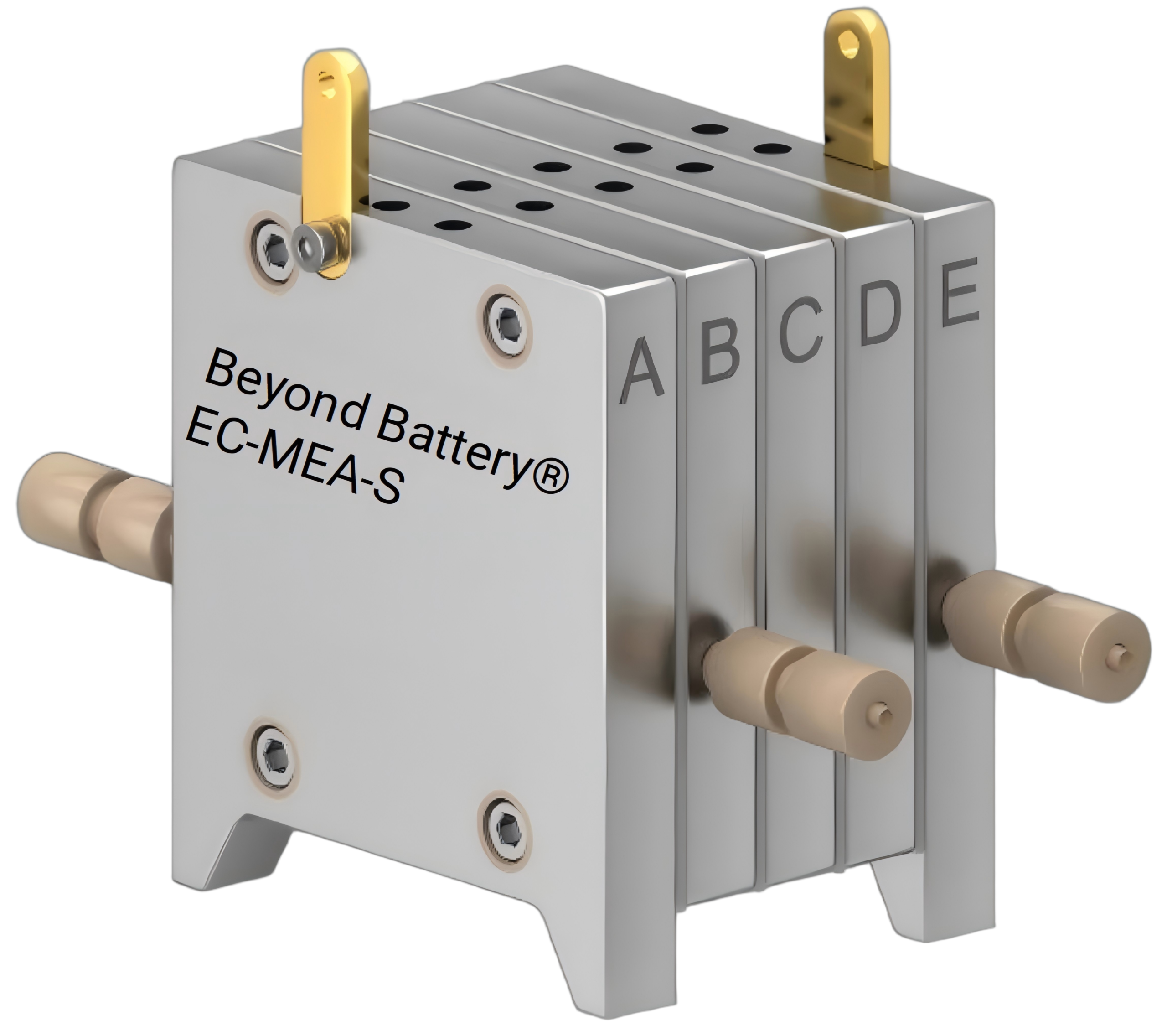
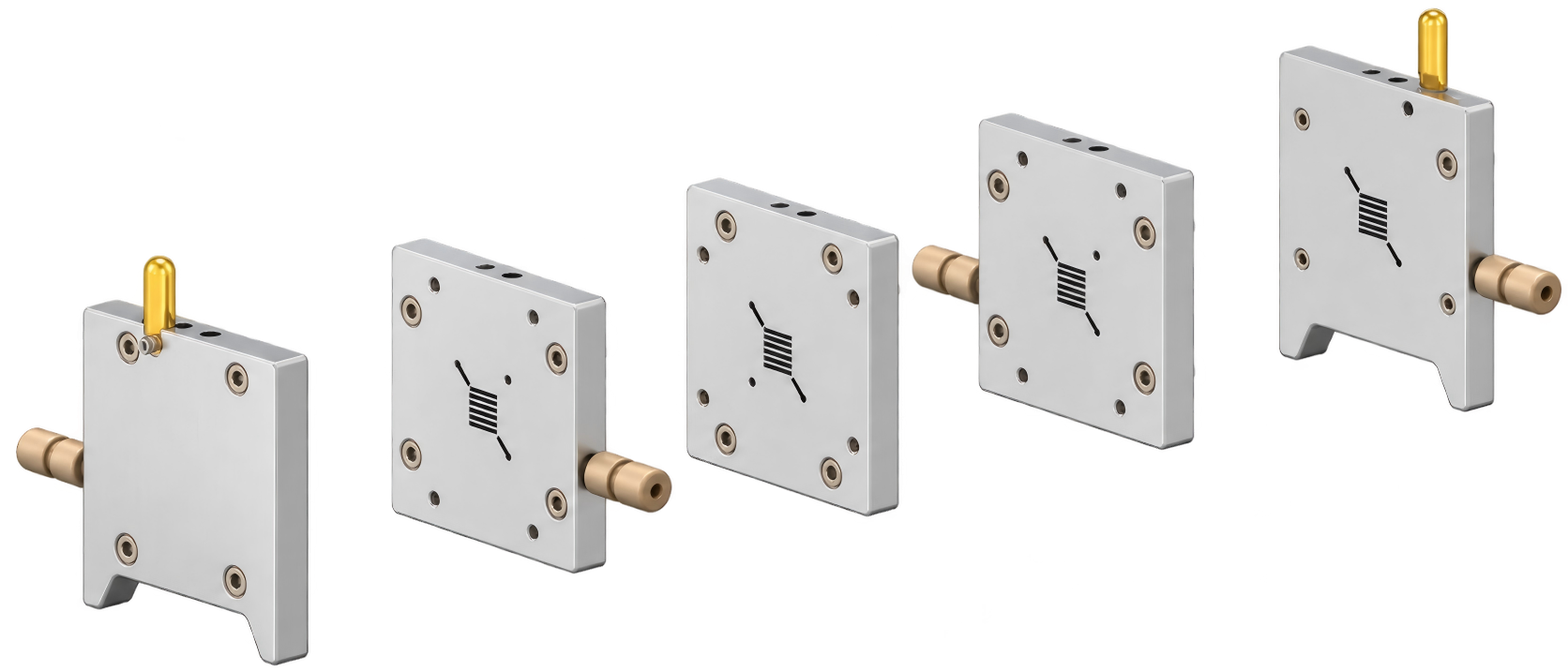
The EC-MEA-S is a modular membrane electrode assembly electrolyzer stack built from independent anode and cathode flow-field plates. Its stacked architecture enables higher voltage and power than a single-cell configuration while supporting configurable multi-cell studies across different flow-field sizes, materials, and routing schemes. Integrated heating and temperature-sensing ports support temperature-controlled testing.
Key Features
- Modular Stack Architecture: Independent anode and cathode flow-field plates support scalable multi-cell assembly with uniform clamping across the stack.
- Configurable Flow-Path Routing: Supports series and series–parallel routing for stack-level reactant-distribution studies.
- Customizable Flow-Field Platform: Supports serpentine, parallel, leaf-vein, spiral, and custom channel geometries across multiple flow-field sizes and plate materials.
Technical Specifications
| Chamber structure | Multi-chamber; dependent on stack configuration |
| Electrode system | Two-electrode |
| Anode / cathode | Sheet-type electrodes |
| Flow-field area | 1, 4, 5, 9, 25, or 100 cm²; customizable |
| Flow-field size | 10 × 10, 20 × 20, 22.4 × 22.4, 30 × 30, 50 × 50, or 100 × 100 mm; customizable |
| Flow-field configuration | Serpentine, parallel, leaf-vein, spiral; customizable |
| Flow-path configuration | Series, series–parallel |
| Flow-field plate material | Ti, Ni, PEEK optional |
| Clamping plate material | Ti |
| Current tab material | Gold-plated copper |
Typical Applications
- CO₂ Electroreduction: Large-area and multi-cell MEA studies for CO₂ conversion.
- Water Electrolysis: Stack studies for hydrogen production under configurable flow and temperature conditions.
- Organic Electrosynthesis: Multi-cell electrochemical synthesis with configurable flow routing.
- Flow-Field & Stack Engineering: Comparative studies of channel geometry, flow distribution, and cell-to-cell consistency.
Flow-Path Configuration Guide
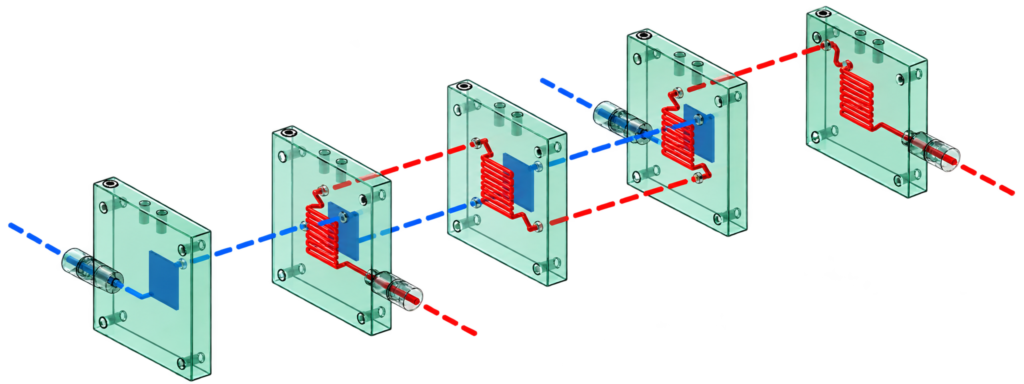
- Series Flow-Path Configuration: Both anode and cathode streams pass sequentially through the stacked cells, making this configuration suitable for water electrolysis and hydrogen production.
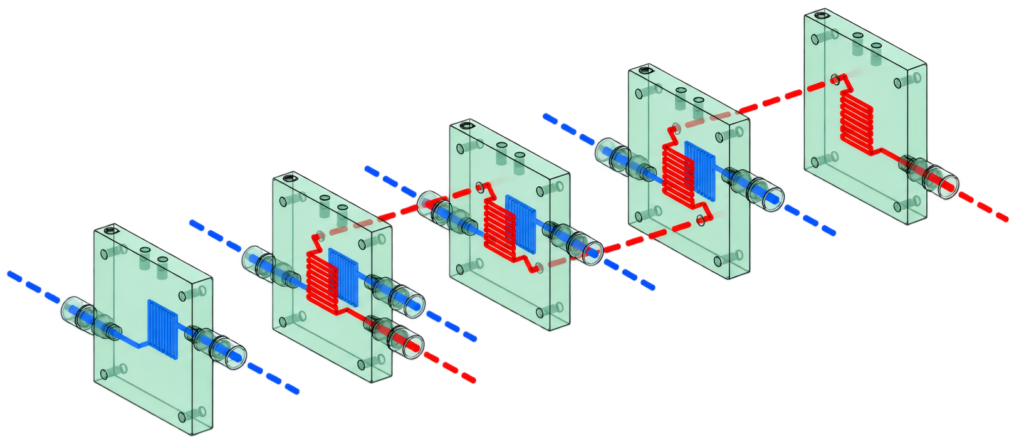
- Series–Parallel Flow-Path Configuration: The cathode stream is routed in series while the anode streams are distributed in parallel, enabling independent flow and rapid removal of anode-generated gas for CO₂ electroreduction studies.
Related Published Application
Scale-Up of CO₂-to-CO MEA Electrolysis from Single Cell to Stack: Hong et al. investigated the scale-up of CO₂-to-CO electrolysis from a 100 cm² single MEA cell to a 300 cm² three-cell stack using engineered serpentine flow fields. During 2 h operation, the stack retained high CO selectivity across 100–300 mA cm⁻², reaching 89.8% FECO at 90 A. The study illustrates key considerations in multi-cell MEA scale-up, including flow distribution and cell-to-cell uniformity.
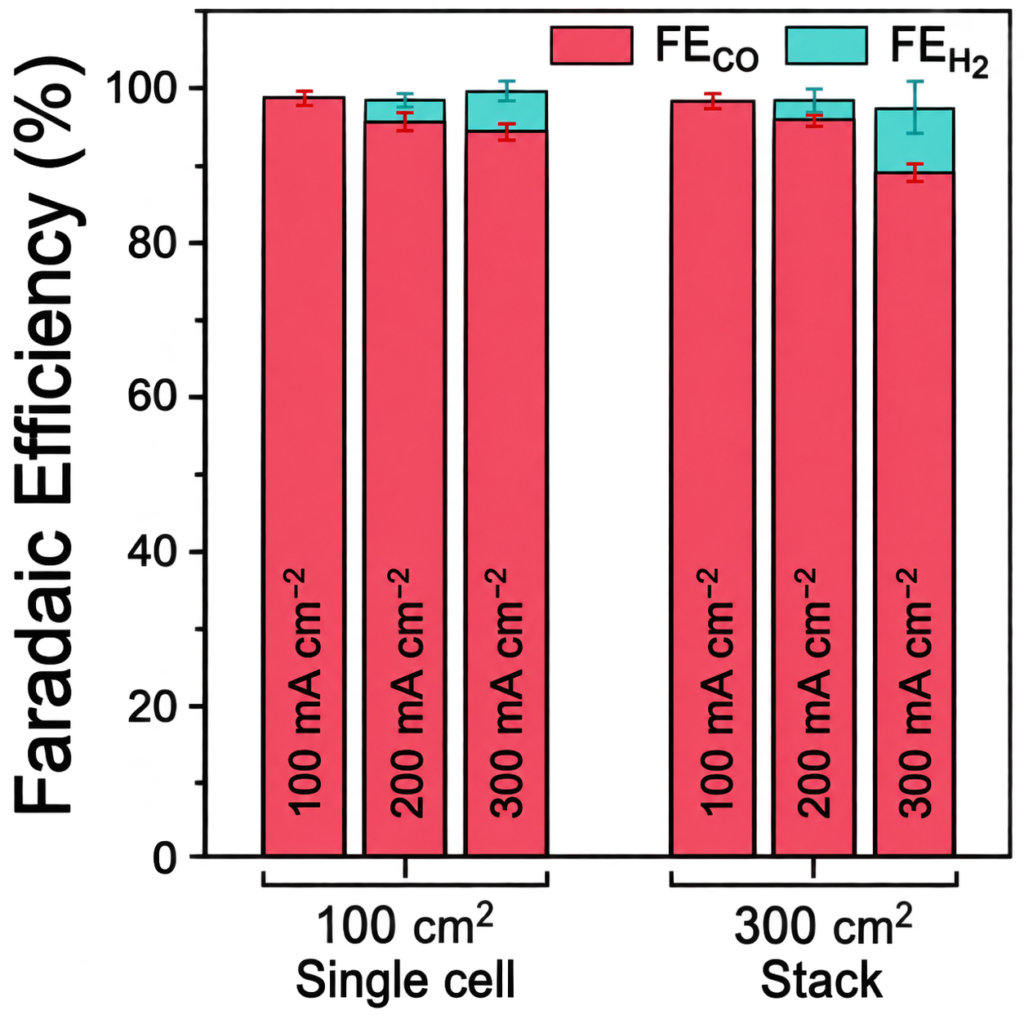
Source: Hong, S. et al. ACS Energy Lett. 2026, 11, 3771–3780.
Capabilities Relevant to the EC-MEA-S
- Demonstrates scale-up from a large-area single MEA cell to a multi-cell stack.
- Illustrates system-level reactant distribution during multi-cell stack operation.
- Shows consistent electrochemical behavior among individual MEAs.
Note: The cited publication used a custom-built MEA stack, not the EC-MEA-S. Its multi-cell architecture and flow-field design are structurally comparable and are included solely as a related application example.

Reviews
There are no reviews yet.