
Description
Product Overview
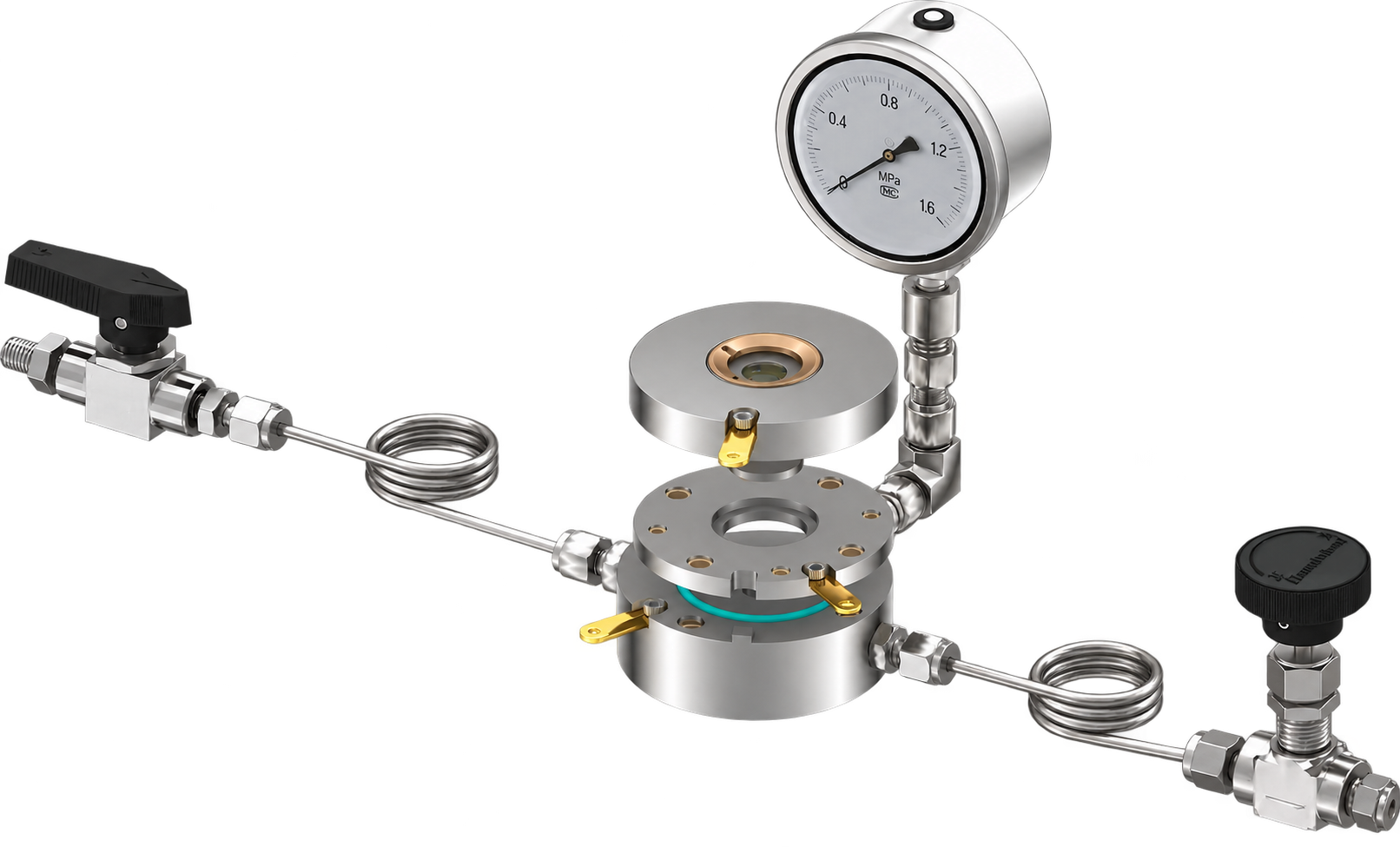
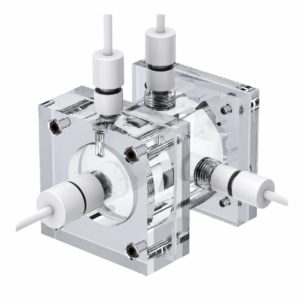
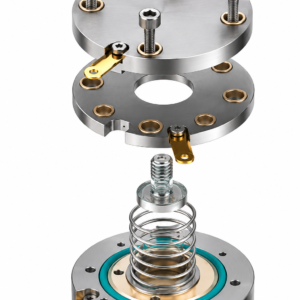
The RM-P3E is a sealed three-electrode battery test cell integrating in situ Raman measurement with electrochemical cycling under controlled pressure or vacuum conditions. Its sapphire optical window and short sample-to-window distance facilitate Raman signal collection, while the three-electrode configuration enables working-electrode potential monitoring against a reference electrode. A high-purity titanium body, PEEK insulation, adjustable spring loading, O-ring sealing, and an integrated pressure gauge support reliable, glovebox-compatible testing under pressurized conditions. Vacuum operation is supported by replacing the pressure gauge with a compatible vacuum gauge.
Key Features
- In Situ Raman Monitoring: Enables real-time Raman characterization of electrode materials during battery charge/discharge operation.
- Three-Electrode Configuration: Supports monitoring of the working-electrode potential against an independently connected reference electrode (lithium wire is excluded).
- Pressure/Vacuum, Glovebox Compatible Design: Combines interchangeable pressure or vacuum monitoring, adjustable spring loading, and airtight O-ring sealing for sealed battery testing.
Technical Specifications
| Electrode configuration | Three-electrode system |
| Sample-to-window distance | < 2 mm |
| Optical window diameter | Ø20 mm |
| Effective optical window diameter | Ø12 mm |
| Maximum pressure | 1 MPa |
| Optical window material | Sapphire |
| Cell body material | Ti |
| Insulation material | PEEK |
| Current collector tab | Gold-plated copper |
| Cell body dimensions | Ø70 mm × H40 mm |
Instrument Compatibility
- Raman System Compatibility: Compatible with commercial Raman microscope systems, including Renishaw (inVia) and HORIBA (LabRAM Soleil Nano).
- Electrochemical Testing Compatibility: Compatible with commercial electrochemical workstations, including Bio-Logic (VSP-3E), and battery testing systems, including LAND (CT3004A).
Related Published Application
In Situ Raman Tracking of Sodium Storage in Hard Carbon: The cell used in this study, supplied by Beyond Battery under product code RM‑3E, was coupled with a HORIBA LabRAM Soleil Nano confocal Raman spectrometer to compare pristine T2 and Bi/N-modified T2-BiN hard-carbon anodes during sodium-ion battery cycling. In situ spectra revealed a pronounced G-band redshift and reduced D-band intensity for T2-BiN, indicating enhanced Na⁺ intercalation-induced C–C bond strain and increased Na⁺ adsorption at defect sites.
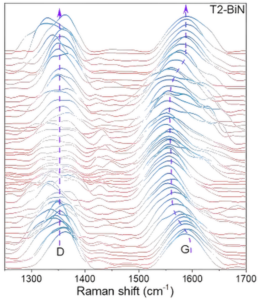
Reproduced from Liu, L. et al. Chem. Sci. 2025, 16, 17630–17639. CC BY 4.0.
Capabilities Relevant to the RM-P3E
- In situ Raman monitoring during battery charge/discharge cycling.
- Comparative tracking of D- and G-band evolution.
- Identification of Na⁺ intercalation and defect-site adsorption.
Note: RM‑3E is the Beyond Battery product code for the same cell reported in the cited publications. The original articles use a different product designation. This study used the base model (RM-3E) of the RM-P3E; the RM-P3E adds pressure monitoring and optional vacuum operation, but neither controlled-pressure nor vacuum Raman measurements were performed in this study.

Reviews
There are no reviews yet.