
Description
Product Description
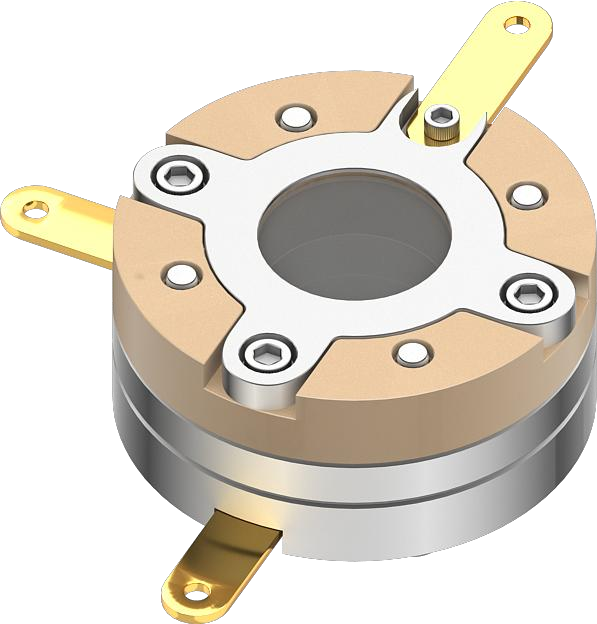
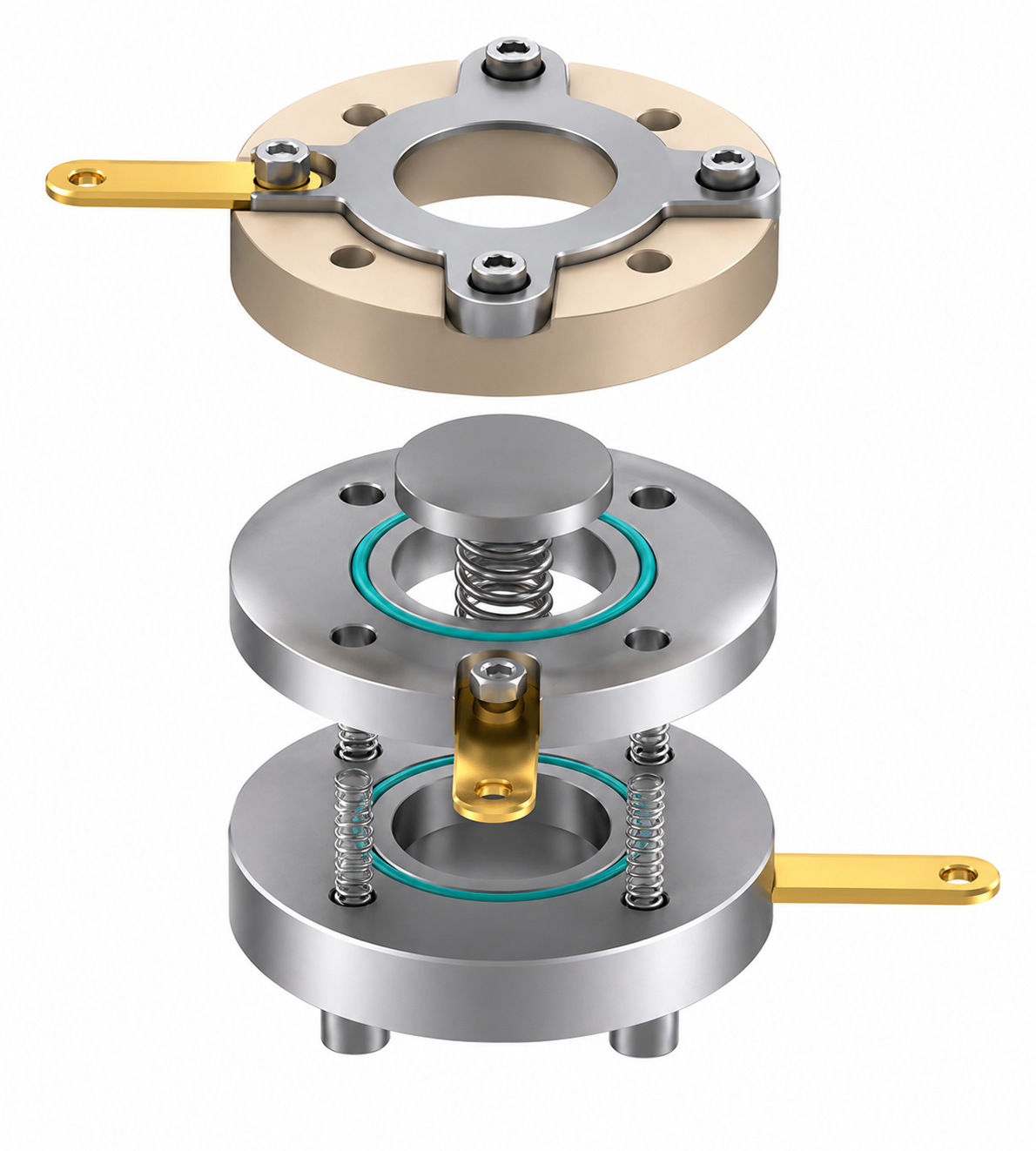
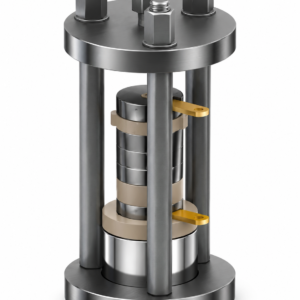
The XRD-3E is a three-electrode in situ XRD battery test cell upgraded from the XRD-2E platform. It enables operando structural analysis during charge/discharge cycling while an independent lithium reference electrode monitors electrode potential. A low-background beryllium window provides direct X-ray access to the electrode stack, while the high-purity titanium body, PEEK insulation, and gold-plated copper tabs support stable, repeatable electrochemical testing.
Key Features
- Independent Reference-Electrode Monitoring: Uses a lithium reference electrode for independent working-electrode potential monitoring during cycling.
- Bruker D8-Compatible XRD Measurement: Designed for use with Bruker D8 X-ray diffractometer systems for operando XRD monitoring during battery cycling.
- Low-Angle XRD Accessibility: Supports XRD measurements from a minimum operating angle of 3°, enabling broader low-angle access for operando configurations.
Technical Specifications
| Minimum operating angle | 3° |
| Effective optical window diameter | Ø20 mm |
| Applicable sample diameter | Ø20 mm |
| Optical window material | Beryllium (Be) |
| Electrode system | Three-electrode |
| Cell body material | Ti |
| Insulation material | PEEK |
| Current collector tab | Gold-plated copper |
| Reference electrode | Lithium wire |
| Cell body dimensions | Ø49.5 mm × H23 mm |
Note: Solid beryllium is relatively stable and poses low skin-contact risk; avoid inhaling dust or aerosols and wash hands after handling.
Instrument Compatibility
- XRD System Compatibility: Compatible with Bruker D8 systems and other X-ray diffractometers with suitable mounting and
scan geometries. The sample holder, incident angle range, beam path, and instrument clearance should be verified before testing. - Electrochemical Testing Compatibility: Compatible with commercial electrochemical workstations and battery testing systems that support three-electrode charge/discharge testing.
Related Published Application
Operando XRD Tracking of Graphite Lithiation: Olgo et al. studied a three-electrode graphite||NMC622 prismatic Li-ion cell using spatially resolved operando synchrotron XRD. The measurements tracked graphite staging transitions from graphite to LiC₁₂ and LiC₆. Compared with relatively uniform lithiation at C/5, 2C charging caused delayed phase evolution and greater local heterogeneity. The stable LFP reference electrode enabled independent monitoring of graphite and NMC622 potentials while causing minimal disturbance to local lithiation behavior.
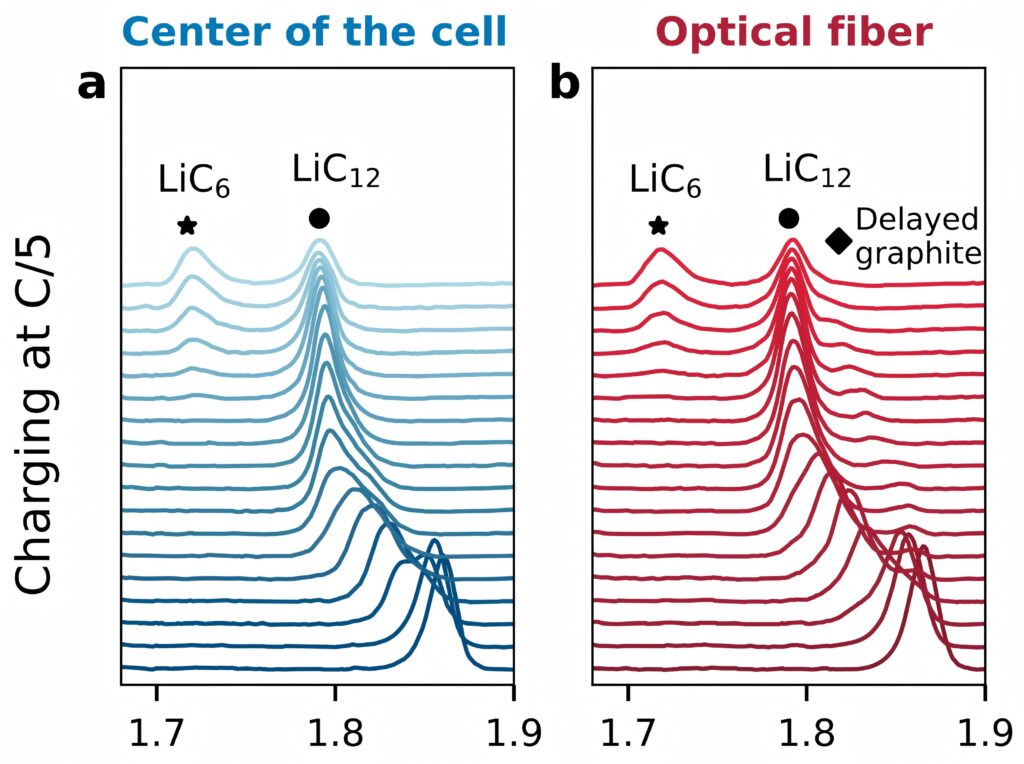
Reproduced from Olgo, A. et al. Nat. Commun. 2024, 15, 10258. CC BY 4.0.
Capabilities Relevant to the XRD-3E
- Independent monitoring of electrode potentials.
- Operando tracking of graphite → LiC₁₂ → LiC₆ transitions.
- Detection of rate-dependent lithiation heterogeneity.
Note: The cited publication used a custom-designed operando XRD battery test cell rather than the Beyond Battery XRD-3E. The reference is included to demonstrate the relevant research methodology and should not be interpreted as describing or evaluating the XRD-3E.

Reviews
There are no reviews yet.