
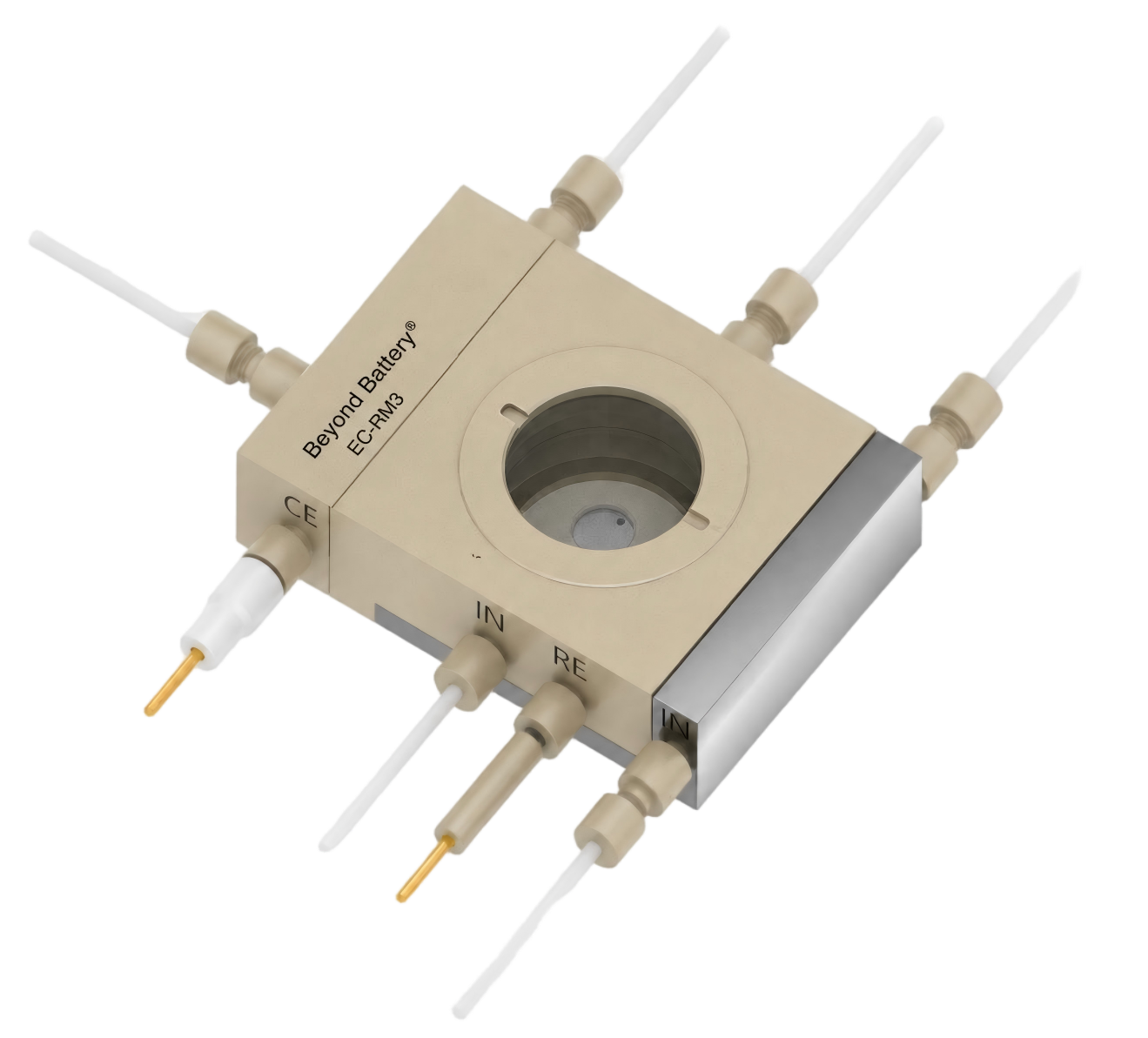


Description
Product Overview
The EC-RM3 combines direct Raman access with a membrane-separated three-chamber configuration for gas-fed electrochemical studies. A dedicated gas channel supplies reactant gas to the working electrode in the cathode chamber, enabling operando investigation of gas–liquid–solid interfaces under three-electrode control.
Key Features
- Gas-Fed Interface Monitoring: Provides direct Raman access to the gas- diffusion cathode interface under continuous reactant gas supply.
- Membrane-Separated Reaction Control: Separates cathodic and anodic compartments to reduce product crossover and minimize inter-reaction interference.
- Operando Interfacial Analysis: Enables real-time investigation of reaction intermediates, catalyst evolution, and gas – liquid–solid interfacial processes.
Technical Specifications
| Working electrode area | 1 cm² (customizable) |
| WE-optical window distance | < 6 mm |
| Optical window diameter | Ø37 mm (effective diameter: Ø34 mm) |
| Chamber structure | Three-chamber |
| Working electrode | Sheet-type gas-diffusion electrode (e.g., Au, Pt; glassy carbon, ITO, and FTO) |
| Reference electrode | Ag/AgCl or Ag/Ag⁺ electrode |
| Counter electrode | Platinum wire electrode or graphite rod electrode |
| Cell body material | PEEK + Ti |
| Optical window material | Quartz |
| Cell body dimensions | L99 × W70 × H25 mm |
Instrument Compatibility
- Raman System Compatibility: Compatible with commercial Raman microscope systems, including Renishaw (inVia Qontor), HORIBA (LabRAM HR Evolution, iHR550), and Ocean Optical Instruments (HRS-5A).
- Potentiostat Compatibility: Compatible with commercial three-electrode electrochemical workstations, including CH Instruments (CHI660E, CHI760E, CHI1140C), Bio- Logic (VMP3), and Corrtest Instruments (CS350M).
Published Application Example
In Situ Raman Monitoring of CO₂ Electroreduction: The cell used in this study, supplied by Beyond Battery® under product code EC-RM3, a modified three-electrode flow-cell configuration, was used to investigate Cu₂O catalysts with controlled surface roughness during CO₂ electroreduction. Catalyst-loaded carbon paper served as the working electrode, with Ag/AgCl and a graphite rod as the reference and counter electrodes. In situ spectroscopy tracked *CO adsorption and Cu⁺ evolution, linking catalyst surface structure to C₂+ product selectivity.
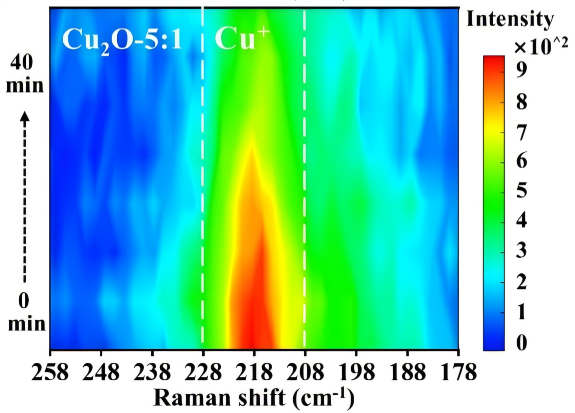
Reproduced from Fang, Q. et al. Chem. Eng. J. 2025, 515, 163293. CC BY 4.0.
Demonstrated EC-RM3 Capabilities
- Operando monitoring in a gas-fed flow-cell configuration.
- Compatibility with catalyst-loaded carbon-paper electrodes.
- Tracking of reaction intermediates and catalyst- state evolution.
Additional Published Applications
- Chang, B. et al. Chem. Eng. J. 2024, 496, 153993.
- Jia, G. et al. Nano Res. 2025, 18, 94907265.
Product Identification Note: EC-RM3 is the Beyond Battery product code for the same cell reported in the cited publications. The original articles use a different product designation.


Reviews
There are no reviews yet.