
Description
Product Overview
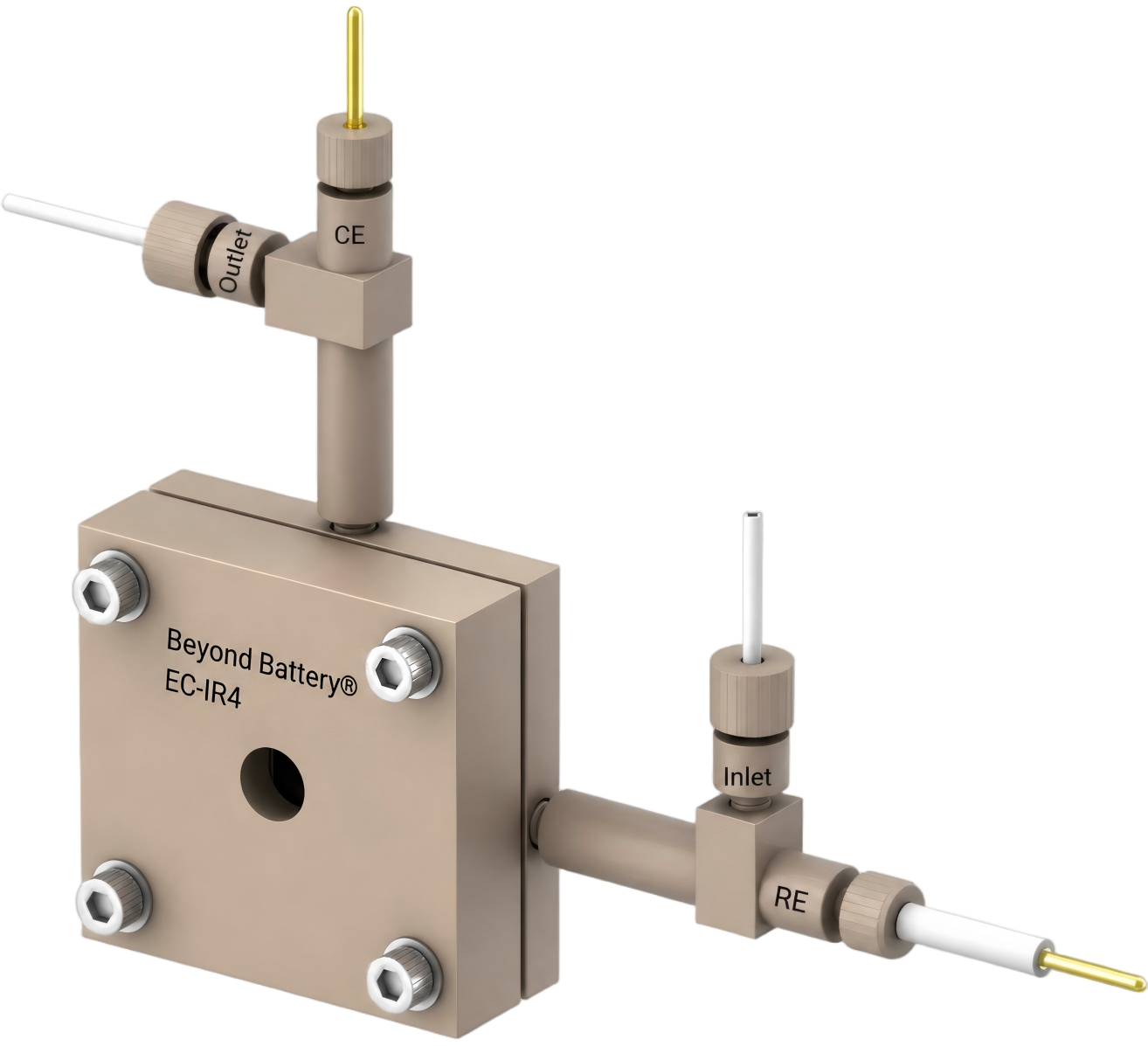
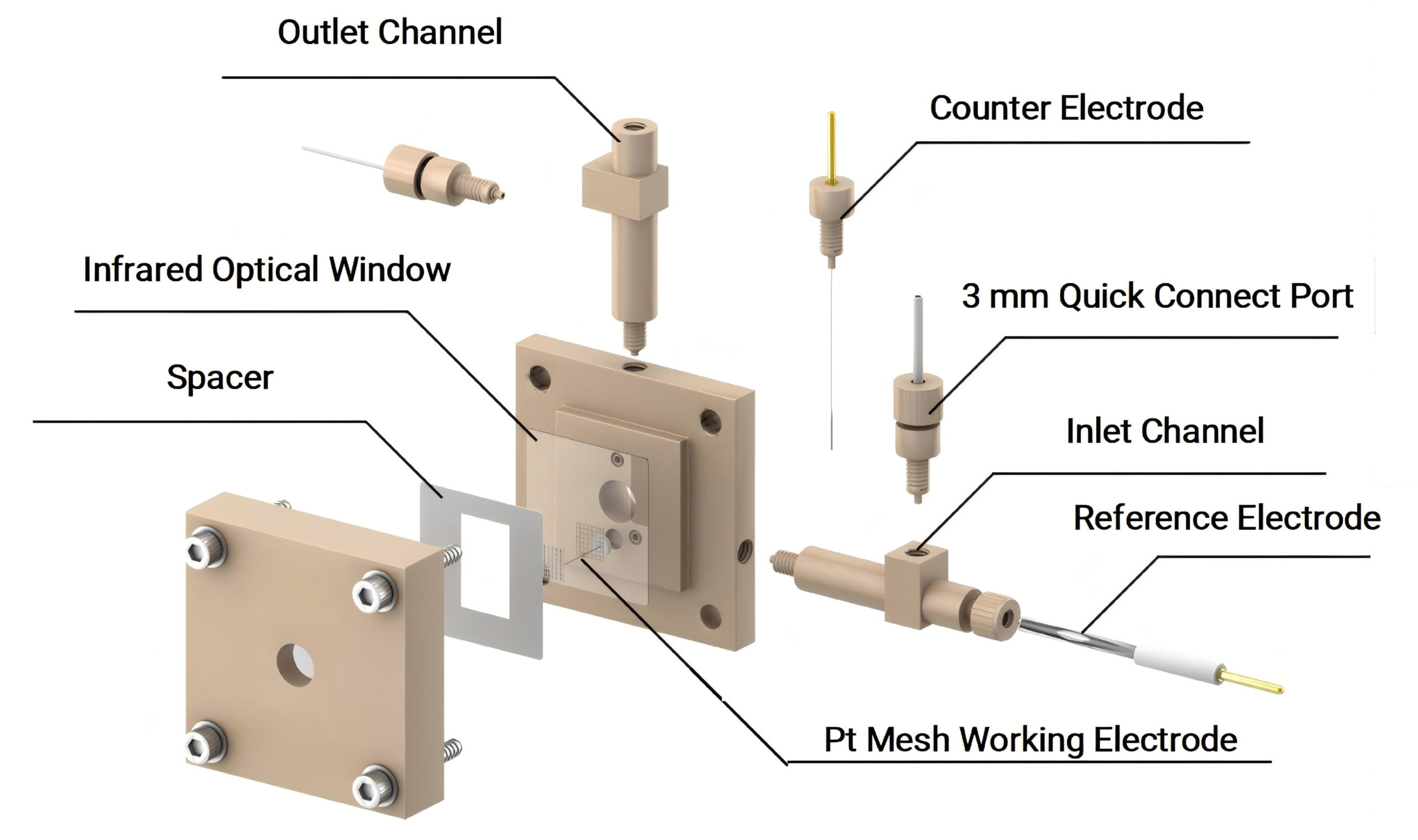
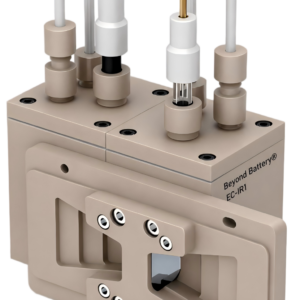
The EC-IR4 is a thin-layer transmission FTIR spectroelectrochemical cell for monitoring electrochemically generated species, reaction intermediates and redox-state changes under potential control. Its platinum mesh working electrode provides an infrared transmission path through the active region, while the CaF window and three-electrode configuration support in situ measurements. Gas inlet and outlet ports enable purging and controlled-atmosphere operation.
Key Features
- Thin-Layer Transmission FTIR Geometry: The CaF optical window and controlled electrolyte layer provide a direct transmission path for potential-dependent FTIR measurements.
- Potential-Controlled Three-Electrode Measurements: Independent electrode connections support in situ spectroelectrochemical measurements under controlled potential.
- Controlled-Atmosphere Operation: Integrated gas inlet and outlet ports enable gas purging and atmosphere control during measurements.
Technical Specifications
| Measurement mode | Transmission FTIR |
| Electrode system | Three-electrode |
| Solution-layer thickness | 0.5 mm |
| Working electrode | Platinum mesh electrode |
| Counter electrode | Platinum wire electrode |
| Reference electrode | Platinum electrode |
| Optical window material | CaF₂ (sold separately) |
| Cell body material | PEEK |
| Optical window size | 34 × 36 mm |
| Clear aperture | Ø10 mm |
| Gas connections | Inlet and outlet ports |
Instrument Compatibility
- FTIR Spectrometer Compatibility: Compatible with commercial FTIR spectrometers supporting transmission measurements. Sample-compartment and optical alignment requirements should be confirmed before use.
- Potentiostat Compatibility: Compatible with commercial potentiostats supporting three-electrode measurements. Connection requirements should be confirmed before use.
Related Published Application
Transmission-Mode IR Spectroelectrochemistry of Electrocatalytic Intermediates: Kiefer et al. used a transmission-mode OTTLE cell equipped with Pt minigrid working and auxiliary electrodes, an Ag-wire pseudoreference electrode, a 200 μm polyethylene spacer and 2 mm CaF₂ windows to investigate Re(bpy)(CO)₃Cl. Potential-dependent FTIR spectra tracked the starting complex, singly reduced species and Re–Re dimer, while 2D-IR cross-peaks at 1948 and 1986 cm⁻¹ confirmed dimer formation in acetonitrile.
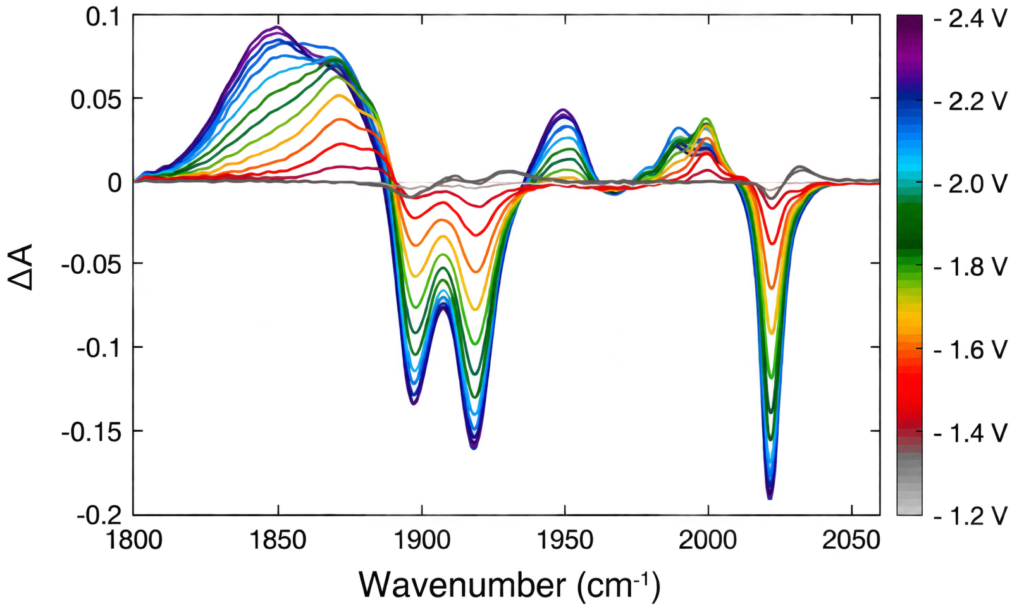
Source: Kiefer, L. M. et al. J. Phys. Chem. Lett. 2021, 12, 3712–3717.
Capabilities Relevant to the EC-IR4
- Enables thin-layer transmission FTIR measurements under electrochemical control.
- Tracks the potential-dependent formation and consumption of solution-phase intermediates.
- Supports controlled-atmosphere studies of molecular electrocatalysts and degradation pathways.
Note: The referenced study used a transmission-mode OTTLE cell with a configuration comparable to the EC-IR4 and is included solely as a related application example.


Reviews
There are no reviews yet.