
Description
Product Overview
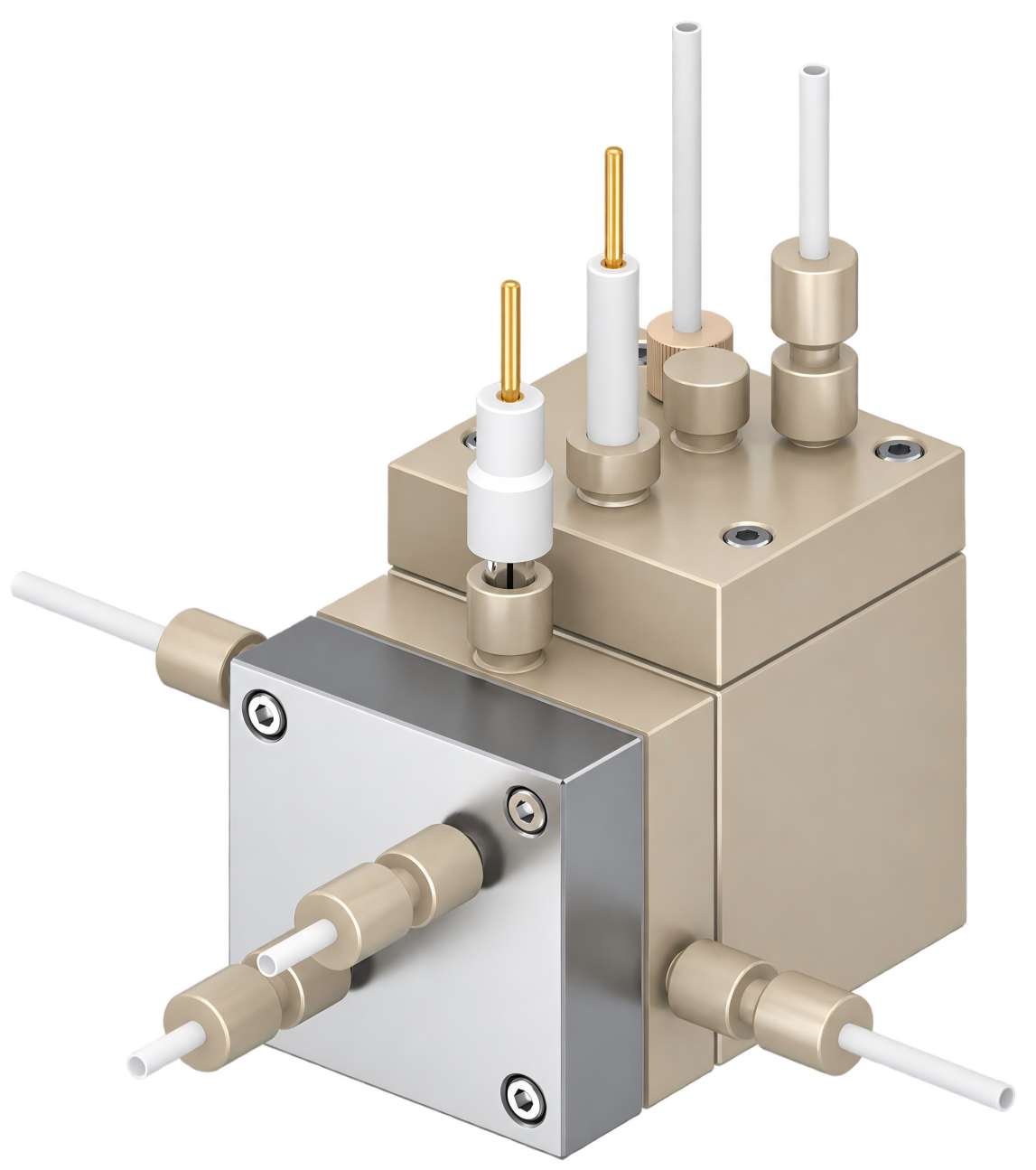
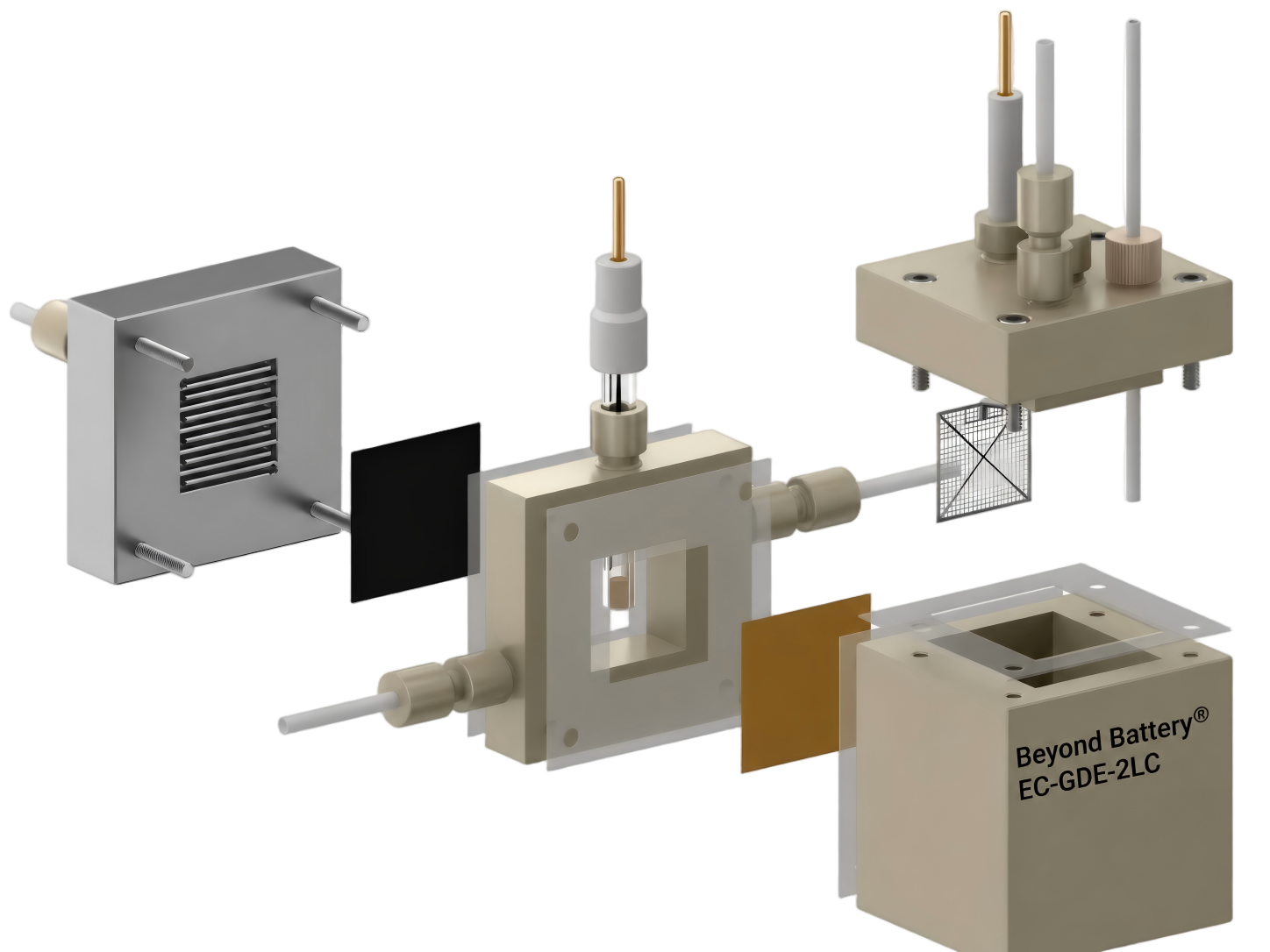
The EC-GDE-2LC is a gas diffusion electrochemical cell designed for gas-fed electrocatalysis and membrane-separated electrochemical studies. Its three-chamber, three-electrode configuration combines a serpentine gas flow field with two enlarged liquid chambers separated by an ion-exchange membrane. This design enables independent control of catholyte and anolyte environments while providing liquid-phase buffering to reduce sensitivity to short-term flow and bubble disturbances. The EC-GDE-2LC supports gas diffusion electrode evaluation, membrane studies, and steady-state electrochemical testing under separated electrode reaction conditions.
Key Features
- Membrane-Separated Dual Liquid Chambers: Two enlarged liquid chambers separated by a membrane enable independent catholyte and anolyte control for electrochemical studies.
- Enhanced Liquid-Phase Buffering: The enlarged liquid chambers provide electrolyte buffering and reduce sensitivity to short-term flow and bubble disturbances.
- Serpentine Gas Flow Field: A defined serpentine flow pathway supports controlled reactant-gas delivery to the gas diffusion electrode.
Technical Specifications
| Chamber Structure | Three-chamber |
| Electrode System | Three-electrode |
| Active Area | 4 cm² (20 × 20 mm, customizable) |
| Gas Flow Field | Serpentine |
| Liquid Chamber Configuration | Membrane-separated dual liquid chambers |
| Working Electrode | Sheet-type gas diffusion electrode |
| Reference Electrode | Rod-type electrode (customer-supplied) |
| Counter Electrode | Sheet-type Pt mesh electrode (customer-supplied) |
| Cell Body Material | Ti + PEEK |
Typical Applications
- Gas Diffusion Electrode Studies: Evaluating sheet-type gas diffusion electrodes under controlled gas delivery and electrolyte-flow conditions.
- CO₂ Electroreduction Research: Investigating catalyst activity, electrochemical response, and product selectivity under membrane-separated electrolyte conditions.
- Membrane-Separated Electrochemical Studies: Studying electrochemical reactions requiring independent catholyte and anolyte environments.
- Steady-State Electrolysis: Supporting continuous-flow electrochemical experiments with enlarged liquid chambers and separated electrode reaction environments.
Configuration & Intended Use
A membrane-separated dual-liquid-chamber configuration that isolates the working/reference electrode side from the counter-electrode side. Suitable for experiments requiring independent catholyte and anolyte environments, membrane studies, and separated electrode reaction conditions.
Related Published Application
Liquid-Phase Buffering in CO₂ Flow Electrolysis: Martens et al. investigated a 10 cm² GDE CO₂ flow cell with a ~3 mL catholyte compartment and current densities up to −1.2 A cm⁻². The limited in-cell electrolyte volume amplified heat and gas-evolution effects: at −0.8 A cm⁻², the catholyte temperature difference across the cell reached ~20 K, while bubble accumulation reduced electrode–electrolyte contact and increased cell resistance. Improving electrolyte conductivity and cooling reduced catholyte temperature by 8–12 K and extended the stable operating range, highlighting the importance of sufficient liquid-phase buffering and effective thermal/gas management in GDE flow electrolysis.
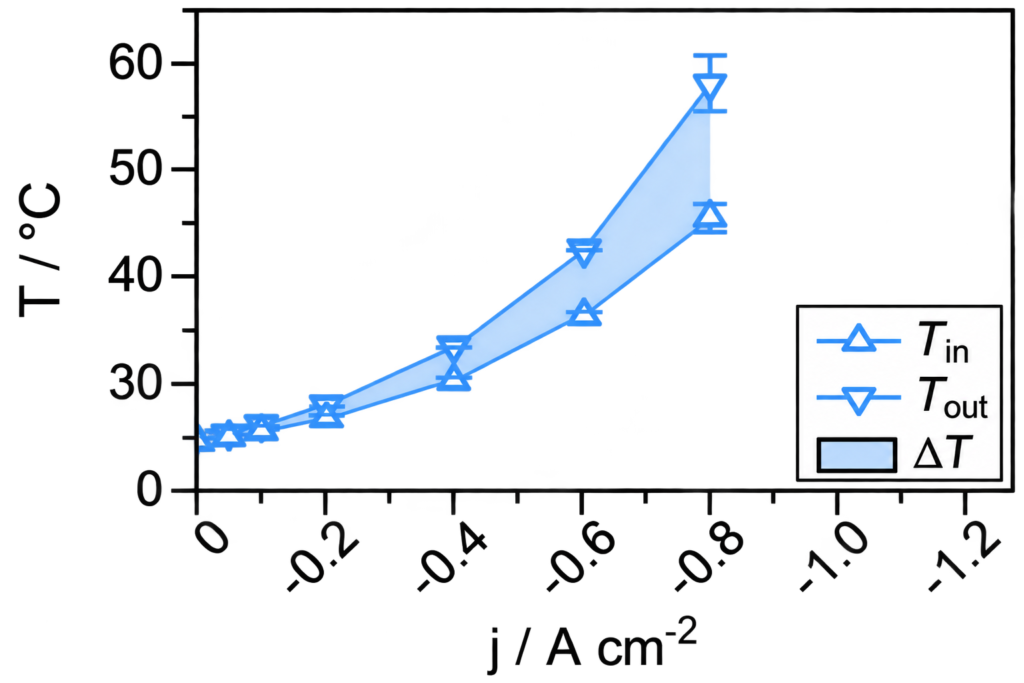
Reproduced from Martens et al., Green Chem., 2023, 25, 7794–7806. CC BY 4.0.
Capabilities Relevant to EC-GDE-2LC
- Gas diffusion electrode evaluation under controlled gas delivery and flow-phase electrochemical conditions.
- Large-liquid-chamber operation with enhanced electrolyte buffering for more stable steady-state testing.
- Membrane-separated electrochemical studies with independent electrode-side electrolyte environments.
Note: The referenced study used a modified ElectroCell micro-flow cell with a configuration comparable to the EC-GDE-2LC and is included solely as a related application example.

Reviews
There are no reviews yet.