
Description
Product Overview
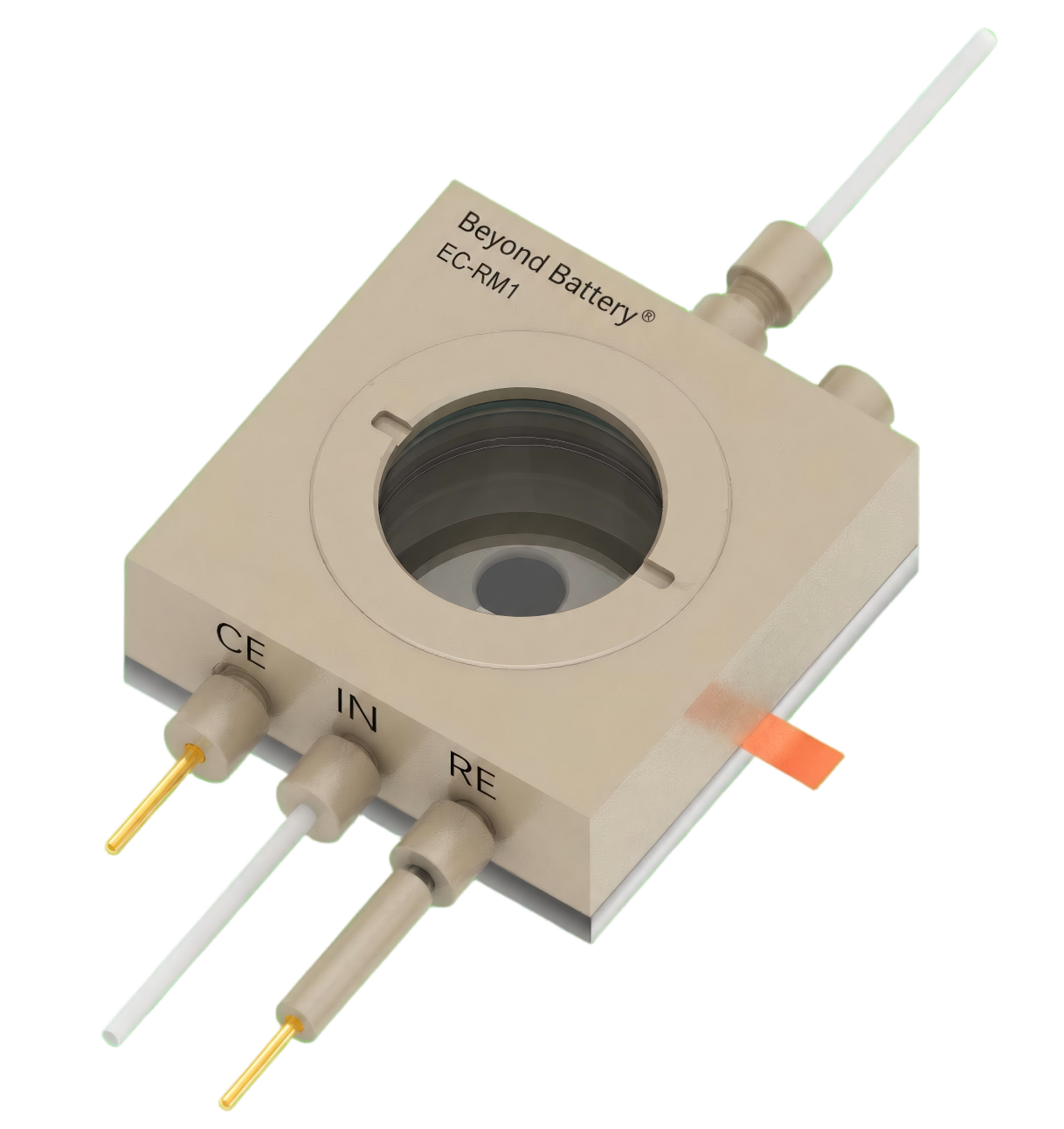
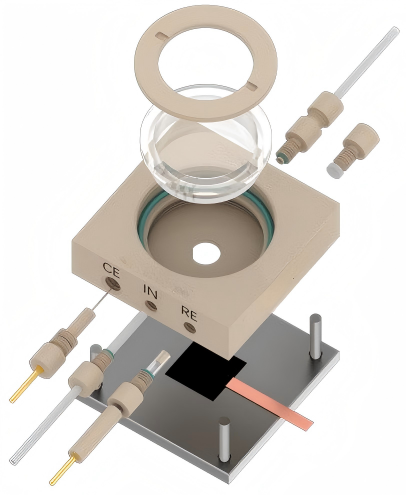
The EC-RM1 provides direct Raman access to a plate-type working electrode through a quartz optical window while maintaining three-electrode electrochemical control. Its compact single-chamber design supports both static electrolyte filling and external electrolyte circulation, making it suitable for mechanistic studies in electrocatalysis, battery materials, and electrochemical interface research.
Product Features
- Direct Interface Observation: Enables direct optical access to a single electrochemical interface for fundamental reaction studies.
- Minimal System Complexity: Single-chamber configuration provides a simplified reaction environment for baseline mechanistic analysis.
- Interface Evolution Analysis: Enables investigation of electrode surface reconstruction and interfacial structural changes during electrochemical operation.
Technical Specifications
| Working electrode area | 1 cm2 (customizable) |
| WE-Optical window distance | < 6 mm |
| Optical window diameter | 37 mm |
| Chamber structure | Single-chamber |
| Working electrode | Sheet-type electrodes (e.g., Au, Pt, glassy carbon, ITO, FTO, and carbon paper), sold separately |
| Reference electrode | Ag/AgCl or Ag/Ag+ electrode |
| Counter electrode | Platinum wire electrode |
| Cell body material | PEEK + Ti |
| Optical window material | Quartz |
| Cell body dimensions | L70 × W70 × H26 mm |
Instrument Compatibility
- Raman system compatibility: Compatible with commercial Raman microscope systems, including Renishaw (inVia Qontor), HORIBA (LabRAM HR Evolution, iHR550), and Ocean Optical Instruments (HRS-5A).
- Potentiostat compatibility: Compatible with commercial three-electrode electrochemical workstations, including CH Instruments (CHI660E, CHI760E, CHI1140C), Bio-Logic (VMP3), and Corrtest Instruments (CS350M).
Published Application Example
- Chen, W. et al. ACS Sustainable Chemistry & Engineering 2025, 13, 11607–11616.
- Lv, H. et al. Nature Communications 2023, 14, 3117.



Reviews
There are no reviews yet.