
Description
Product Overview
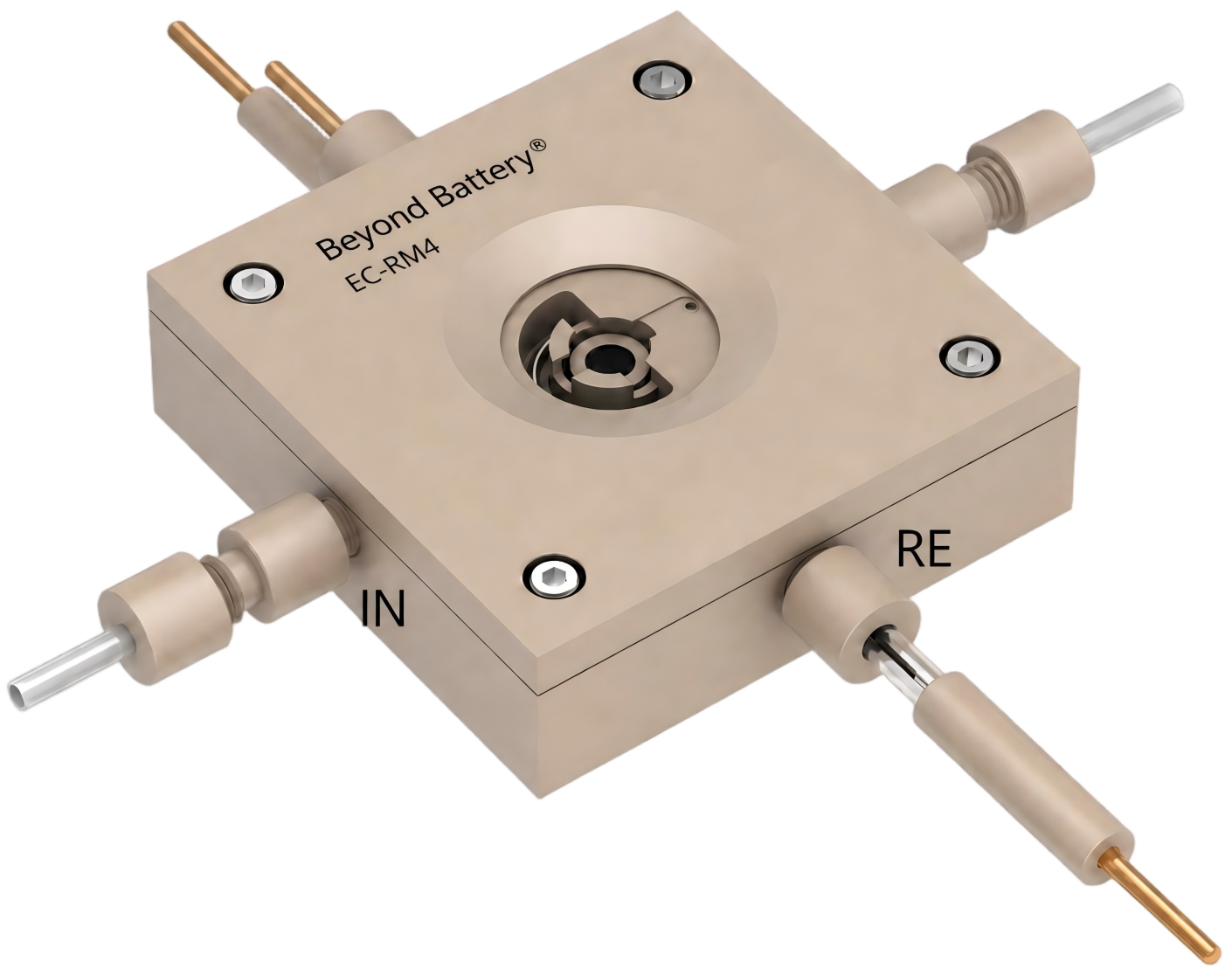
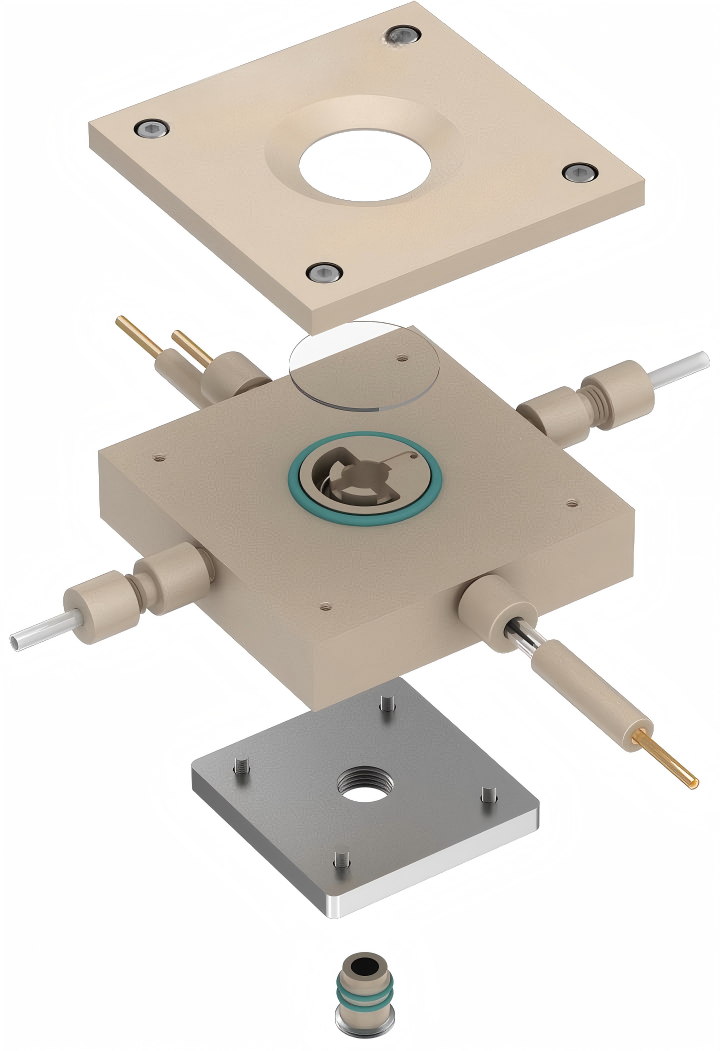
The EC-RM4 is designed for in situ Raman characterization of electrode materials during electrochemical testing. The working electrode is positioned directly beneath a transparent optical window, enabling spectral acquisition during operation. Its PEEK and high-purity titanium construction supports flow-system testing and syringe-based electrolyte filling, while allowing rapid assembly, disassembly, and cleaning.
Key Features
- Short Optical Path: A WE-optical window distance of less than 3 mm supports Raman acquisition from the working electrode.
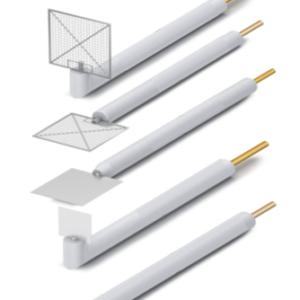
- Interchangeable Disk Electrodes: Supplied with a Ø5 mm glassy carbon electrode and compatible with optional Au, Pt, and Ag disk electrodes.
- Flexible Electrolyte Handling: Supports flow-system operation and direct electrolyte filling using a syringe.
Technical Specifications
| WE-optical window distance | <3 mm |
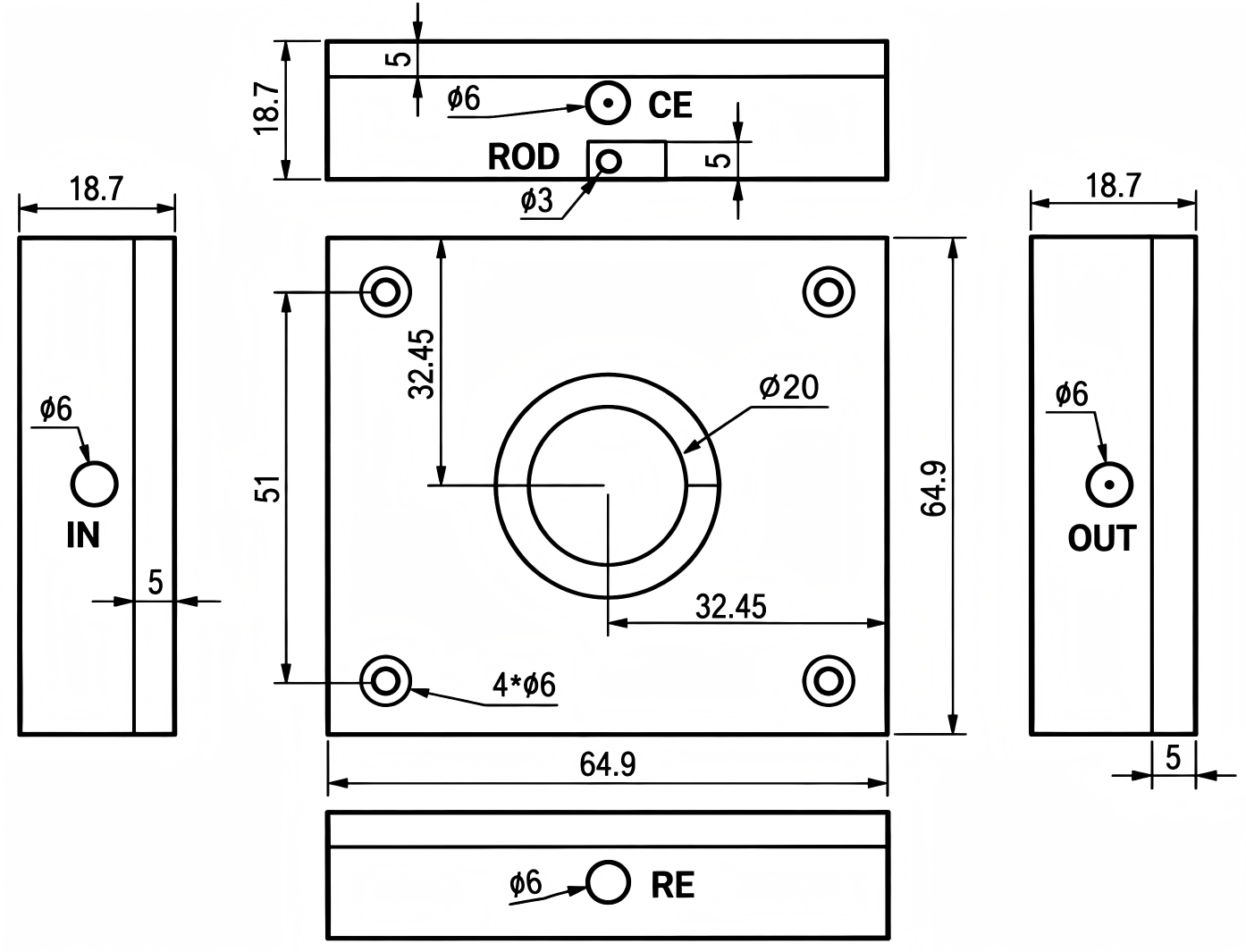
| Optical window diameter | Ø25 mm (effective diameter Ø20 mm) |
| Chamber structure | Single-chamber |
| Electrode system | Three-electrode |
| Working electrode | Ø5 mm glassy carbon disk electrode (standard); Au, Pt, Ag, or other disk electrodes (optional) |
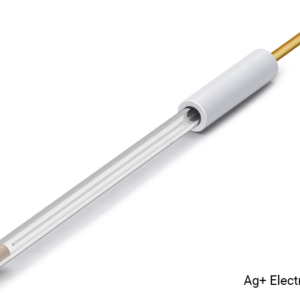
| Reference electrode | Ag/AgCl or Ag/Ag+ electrode |
| Counter electrode | Platinum wire electrode |
| Cell body material | PEEK + Ti |
| Optical window material | Quartz |
| Cell body dimensions | L65 × W65 × H19 mm |
Instrument Compatibility
- Raman System Compatibility: Compatible with commercial Raman microscope systems, including WITec (alpha300 R), Renishaw (inVia), and HORIBA (XploRA, LabRAM HR).
- Potentiostat Compatibility: Compatible with commercial three-electrode electrochemical workstations, including Donghua Testing Technology (DH7001A), CH Instruments (CHI1140C), Corrtest Instruments (CS2350), and DHElecchem systems.
Published Application Example
In Situ Raman Detection of Cuᵟ⁺–OH Species during CO₂-to-Ethylene Conversion: The cell used in this study, supplied by Beyond Battery under product code EC-RM4, an in situ Raman spectroelectrochemical cell, was used to monitor Cu/200-C₃N₄ during CO₂ electroreduction. Time-resolved spectra revealed signals assigned to Cu–CO₂, Cuδ⁺–OH, *OCCHO, *COO-related species, and adsorbed *CO. Combined with ATR-FTIR spectroscopy and DFT calculations, the results indicated that stabilized Cuδ⁺–OH species promoted asymmetric *CO–*CHO coupling, steering the reaction pathway toward ethylene.
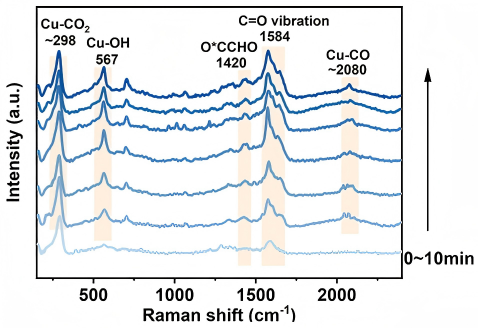
Reproduced from Wang, L. et al. Inorg. Chem. Front. 2026, 13, 1938–1945. CC BY 4.0.
Demonstrated EC-RM4 Capabilities
- Time-resolved in situ Raman monitoring during CO₂ reduction.
- Detection of Cuᵟ⁺–OH and carbon-containing intermediates.
- Mechanistic investigation under electrochemical reaction conditions.
Product Identification Note: EC-RM4 is the Beyond Battery product code for the same cell reported in the cited publications. The original articles use a different product designation.
Additional Published Applications
- Han, M. et al. Catal. Sci. Technol. 2026, 16, 4323–4327.
- Tao, K. et al. Nanoscale Adv. 2026, 8, 3761–3768.



Reviews
There are no reviews yet.