
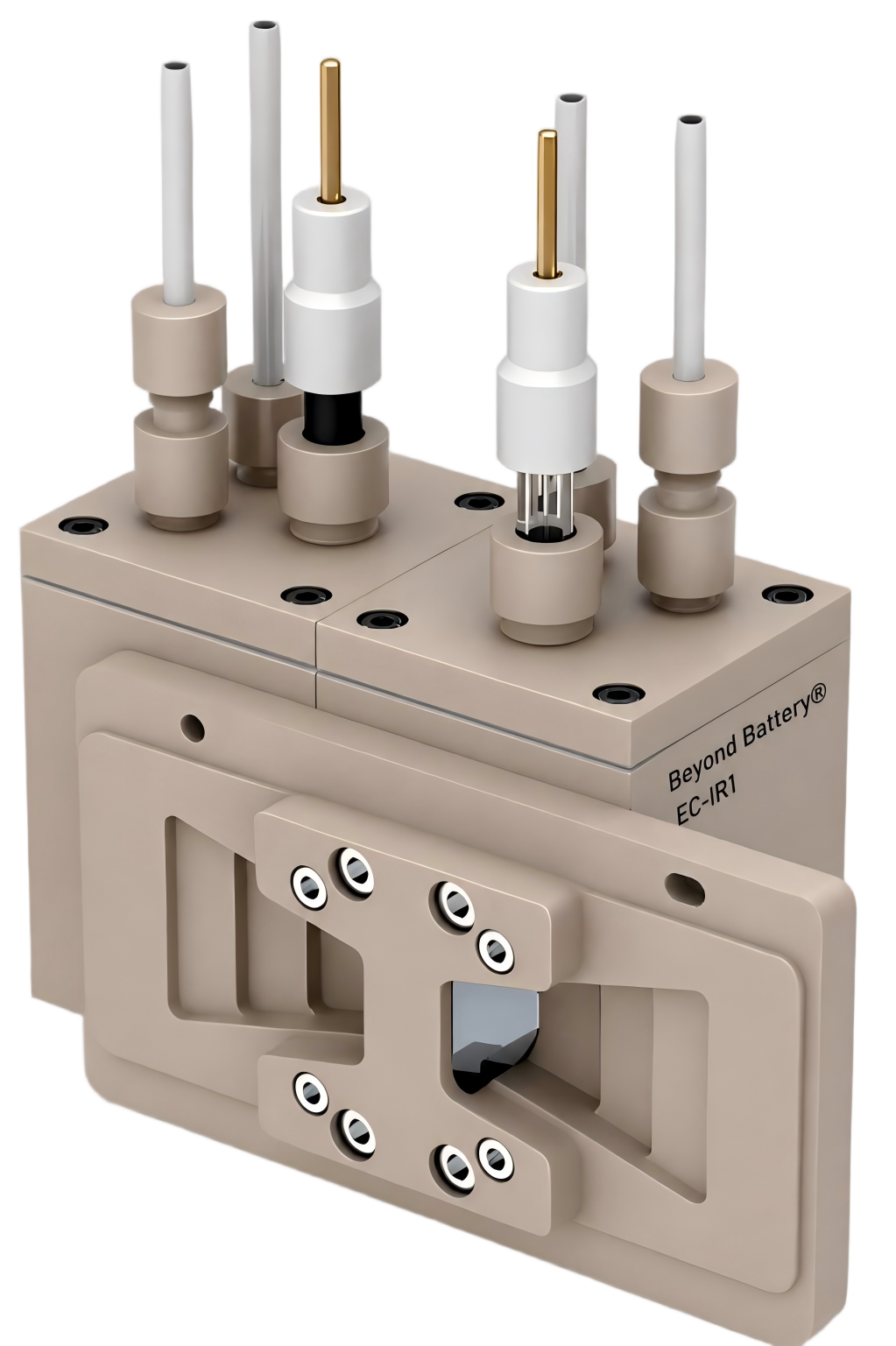
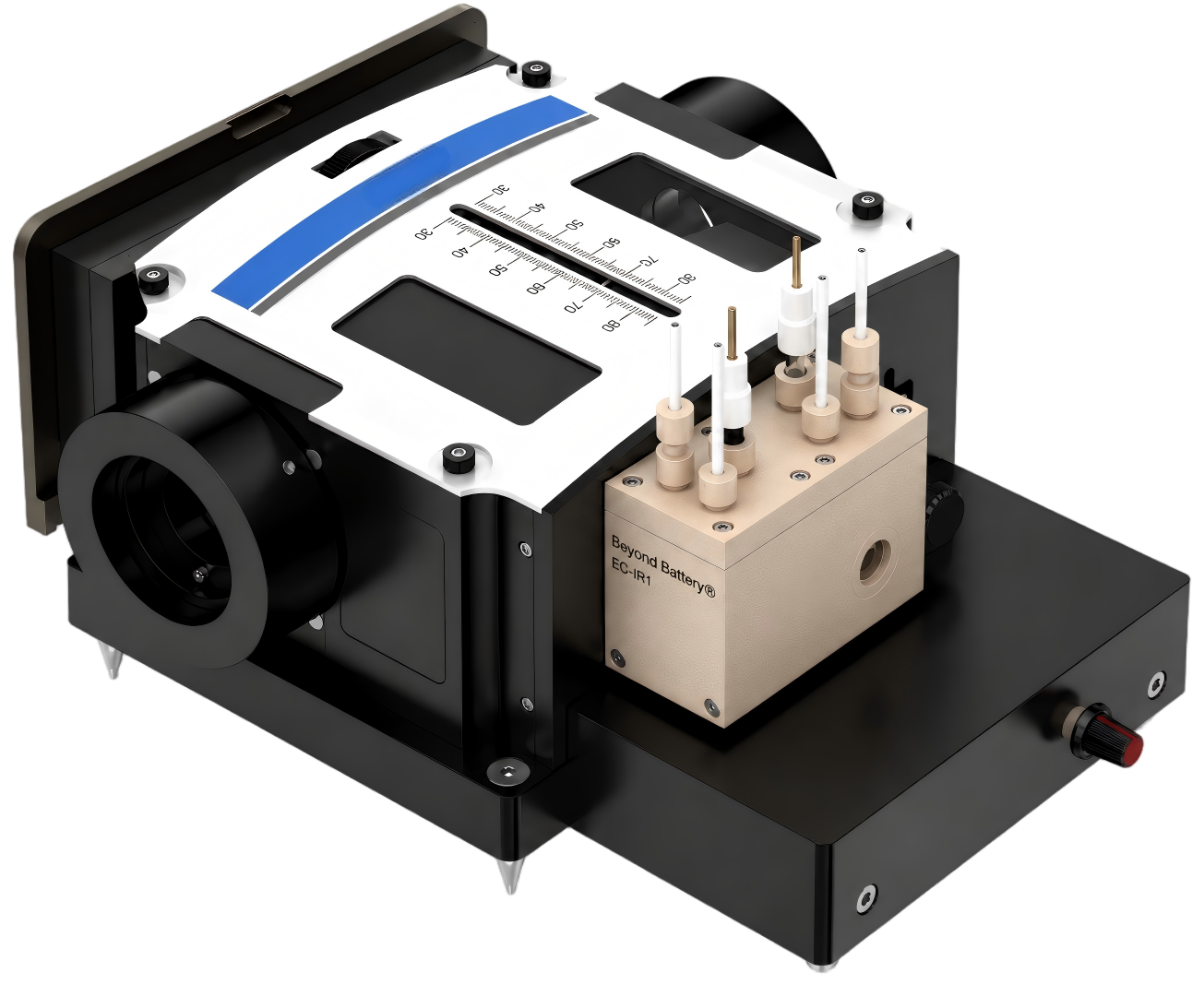
Description
Product Description
The EC-IR1 is an H-type, two-chamber in situ infrared spectroelectrochemical cell designed for internal-reflection ATR-SEIRAS measurements. Its Au-coated single-crystal Si working substrate enables surface-sensitive analysis of adsorbed species and reaction intermediates under electrochemical control. A replaceable membrane separates the two chambers, while bottom magnetic stirring and independent gas inlet/outlet ports support controlled electrolyte mixing and gas handling.
Key Features
- Internal-Reflection ATR-SEIRAS: Supports surface-sensitive infrared measurements of adsorbed species and reaction intermediates using an Au-coated Si working substrate.
- Membrane-Separated Two-Chamber Design: Separates the electrolyte chambers using a replaceable membrane, with independent gas inlet/outlet ports.
- Bottom Magnetic Stirring: Provides controlled electrolyte mixing during potential-dependent infrared measurements of electrode interfaces.
Technical Specifications
| Chamber structure | Two-chamber (H-type) |
| Electrode system | Three-electrode |
| Reflection configuration | Internal reflection (ATR-SEIRAS) |
| Cell volume | < 20 mL |
| Working electrode | Au-coated single-crystal Si |
| Counter electrode | Graphite electrode |
| Reference electrode | Ag/AgCl electrode |
| Optical window material | Single-crystal Si |
| Cell body material | PEEK |
Working Principle
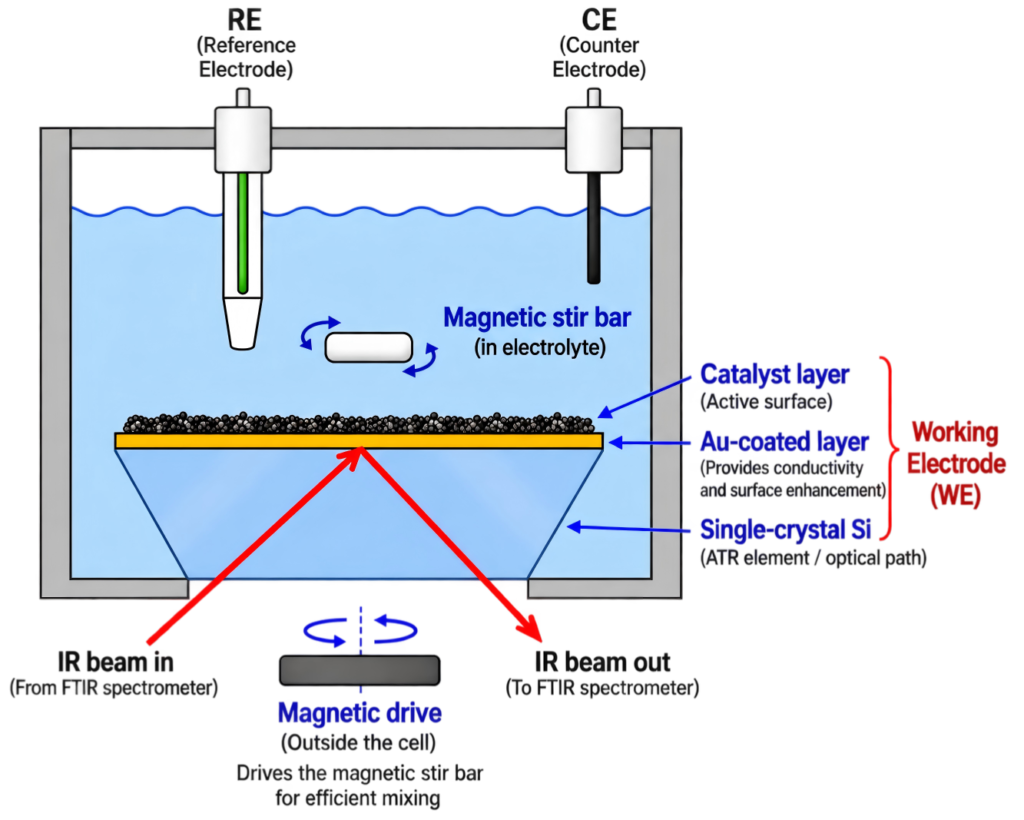
In the EC-IR1, an infrared beam enters the single-crystal Si internal reflection element (IRE) and undergoes internal reflection at the Au-coated interface. The resulting evanescent field probes adsorbed species and reaction intermediates at the working-electrode surface, enabling potential-dependent ATR-SEIRAS measurements. Bottom magnetic stirring improves electrolyte mixing and mass transport during electrochemical operation.
Measurement Configuration
The EC-IR1 employs an internal-reflection ATR-SEIRAS configuration with an Au-coated single-crystal Si working electrode and bottom magnetic stirring. It is suited to surface-sensitive monitoring of adsorbed species and reaction intermediates at the electrode–electrolyte interface, particularly on catalyst-coated Au/Si substrates. The cell is designed for use with the PIKE Technologies VeeMAX III optical accessory (required; sold separately).
Published Application Example
Facet-Dependent CO Adsorption during CO₂ Electroreduction: The EC-IR1 was employed for internal-reflection ATR-SEIRAS measurements of adsorbed CO intermediates on Cu films with different facet exposure during CO₂ electroreduction. Using catalyst-coated Au/Si working electrodes in 0.1 M KOH, potential-dependent spectra distinguished linearly bonded CO (~2050 cm⁻¹) from bridge-bonded CO (~1800 cm⁻¹). Higher *CO coverage on Cu(100)-rich HRS-Cu supported enhanced C–C coupling toward C₂+ products. Separate flow-cell tests achieved Faradaic efficiencies of 58.6% for ethylene and 86.6% for C₂+ products.
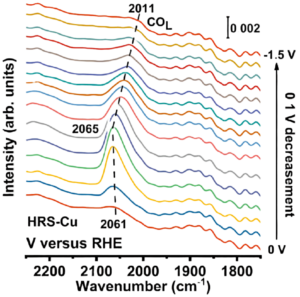
Reproduced from Zhang, G. et al. Nat. Commun. 2021, 12, 5745. CC BY 4.0.
Demonstrated EC-IR1 Capabilities
- Internal-reflection ATR-SEIRAS using catalyst-coated Au/Si working electrodes.
- Potential-dependent monitoring of linearly and bridge-bonded CO species.
- Comparative investigation of catalyst facets and reaction pathways.
Product Identification Note: The source product manual identifies EC-IR1 as the Beyond Battery® product code corresponding to the cell reported in the cited publication. The original article uses a different product designation.

Reviews
There are no reviews yet.