
Description
Product Overview
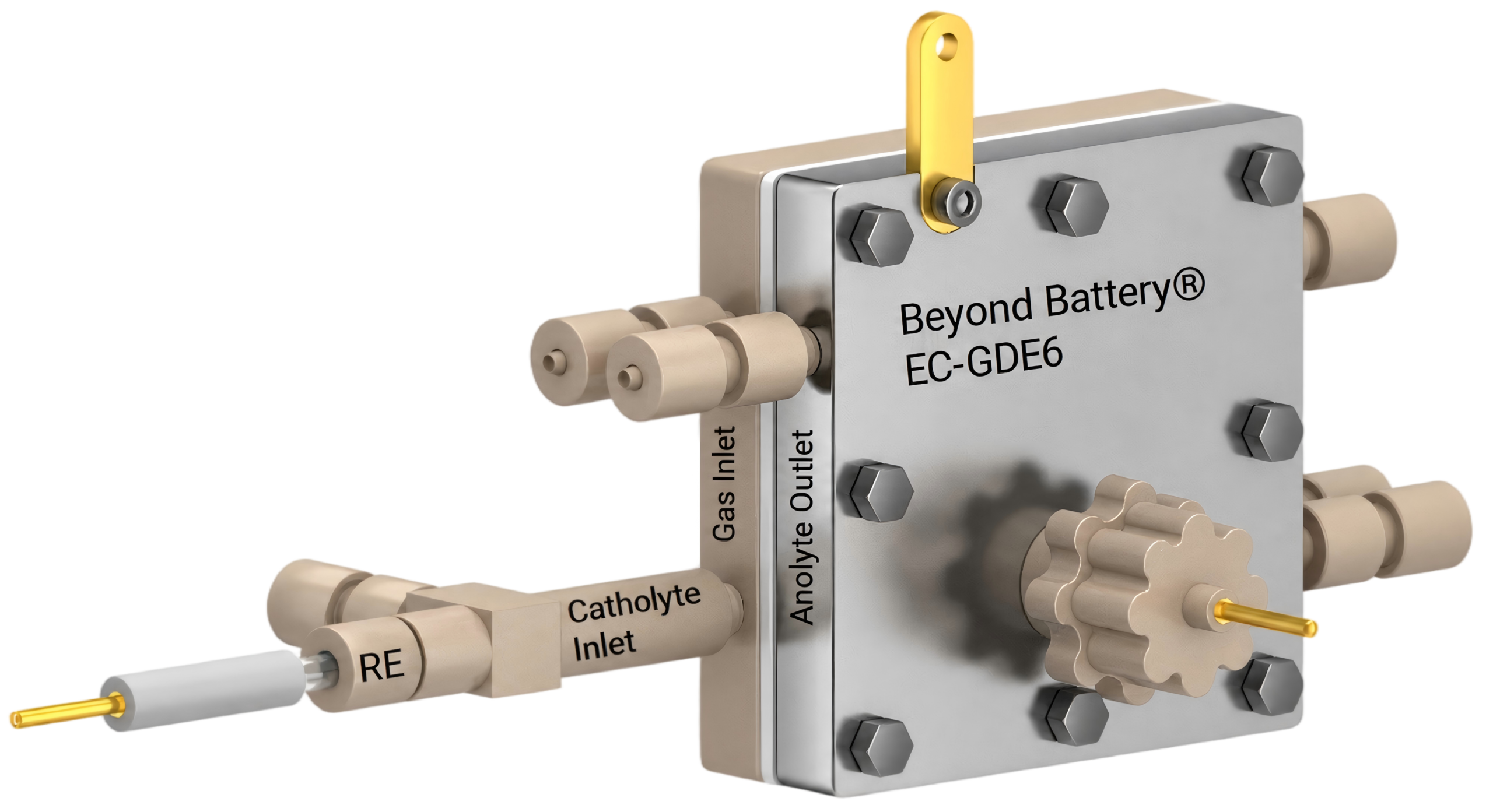
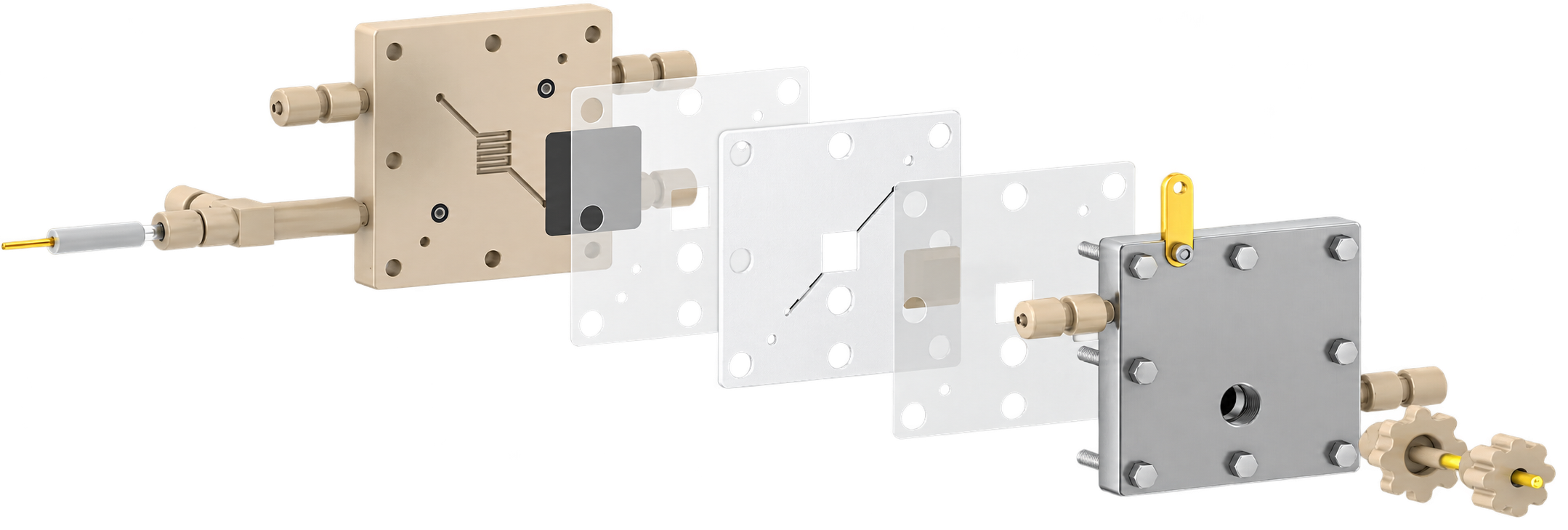
The EC-GDE6 is an advanced gas diffusion electrochemical cell designed for gas-fed electrochemical testing at medium-to-high current densities and long-duration stability studies. Its three-chamber, three-electrode architecture combines high-purity titanium plates with a PEEK cell body. A serpentine gas flow field increases gas contact with the cathode, while the redesigned catholyte pathway reduces the working-to-counter-electrode gap to 0.4 mm.
Key Features
- 0.4 mm Ultra-Short Electrode Gap: The redesigned catholyte pathway minimizes the distance between the working and counter electrodes.
- Serpentine Gas Flow Field: The standard serpentine channel extends gas contact with the cathode; custom flow patterns are available.
- Designed for Demanding Operation: Supports medium-to-high current densities and extended stability testing.
Technical Specifications
| Chamber structure | Three-chamber |
| Electrode system | Three-electrode |
| Anode-cathode gap | 0.4 mm |
| Active area | 1 or 4 cm² (10 x 10 mm or 20 x 20 mm, customizable) |
| Working electrode | Sheet-type gas diffusion electrode (customer-supplied) |
| Reference electrode | Rod-type Ag/AgCl electrode |
| Counter electrode | Sheet-type IrO₂ mesh electrode (customer-supplied) |
| Cell body material | Ti + PEEK |
| Gas flow field | Serpentine (customizable) |
Instrument Compatibility
- Gas and Electrolyte Flow Compatibility: Compatible with regulated laboratory gas supplies and electrolyte-circulation systems equipped with mass flow controllers, gas flow meters and peristaltic pumps.
- Potentiostat Compatibility: Compatible with commercial potentiostats supporting three-electrode measurements, including CH Instruments (CHI660E, CHI760E, CHI1140C), Bio-Logic (VMP3), Corrtest Instruments (CS350M), Ivium Technologies (CompactStat.e20250), and Metrohm Autolab (PGSTAT204).
Related Published Application
Effects of Catholyte Flow Design on CO₂ Electrolysis: Filippi et al. evaluated four 3D-printed PEEK catholyte compartments—Linear-wide, Shifted, Serpentine and Linear—in a 5 cm² CO₂ flow electrolyzer. The system incorporated a PTFE/CuO gas diffusion cathode, an Ag/AgCl reference electrode, a Ni-foam anode and an anion-exchange membrane. All configurations used a gasket-defined 0.2 mm catholyte gap and were tested from 50 to 700 mA cm⁻². Experiments and CFD simulations demonstrated that catholyte hydrodynamics govern bubble removal, local pH and product selectivity, with balanced flow velocities of 0.01–0.1 m s⁻¹ favouring C₂+ production.
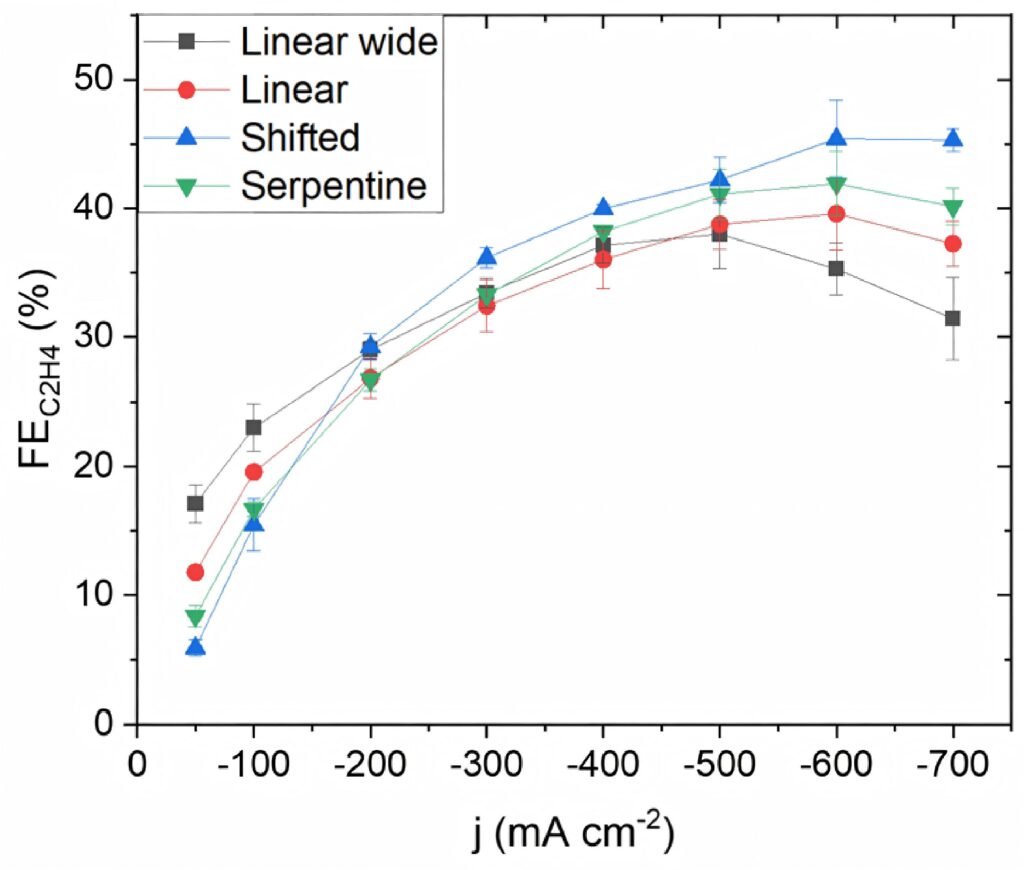
Reproduced from M. Filippi et al., Energy Environ. Sci. 2023, 16, 5265–5273. CC BY 4.0.
Capabilities Relevant to the EC-GDE6
- Illustrates CO₂ electroreduction at 50–700 mA cm⁻² in a custom-built thin-gap, three-electrode flow cell.
- Demonstrates the use of thin catholyte gaps for medium-to-high-current-density GDE testing.
- Highlights the effects of catholyte flow and bubble removal on activity and product selectivity.
Note: The referenced study used a custom-built 5 cm² CO₂ flow electrolyzer with a 0.2 mm catholyte gap and a configuration comparable to the EC-GDE6. It is included solely as a related application example and does not indicate that the EC-GDE6 was used in the study.




Reviews
There are no reviews yet.